Mountains and Waterfalls

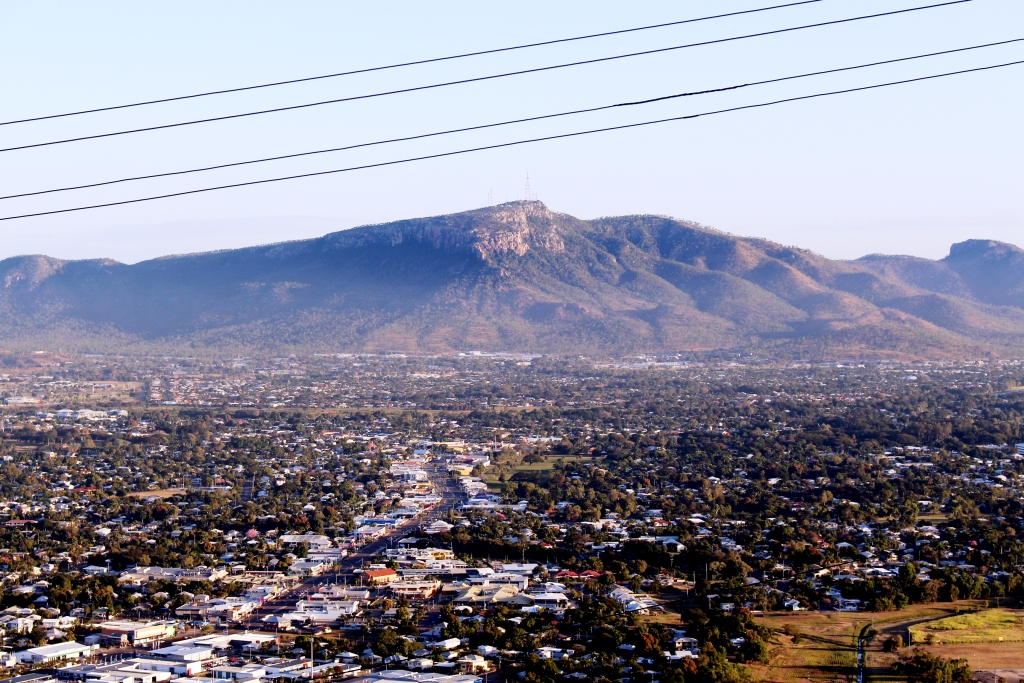
Townsville has a wonderful mountain. It is called Castle Hill. Its battlements tower over the Central Business District with the scenic Strand running along its eastern foundations.
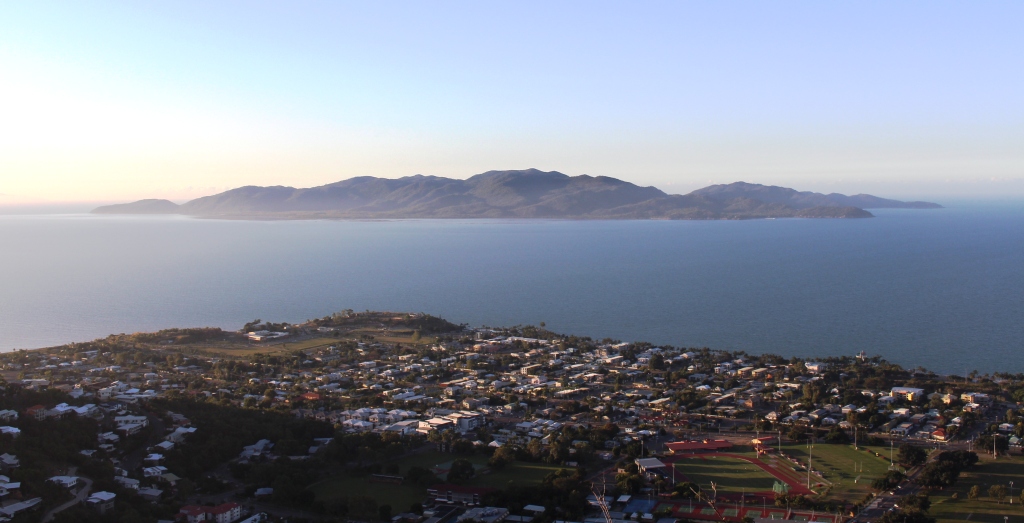
Magnetic Island offshore from Townsville's beach side suburbs

Magnetic Island offshore from Townsville’s beach side suburbs

Great views are to be enjoyed from this vantage point that sweep from Magnetic Island to the east, to the sprawling western suburbs and to coastal plains and mountains to north and south. To the south west stands Townsville’s other viewing platform Mount Stuart, with the regimented neatness of the Army’s Lavarack Barracks at its feet.
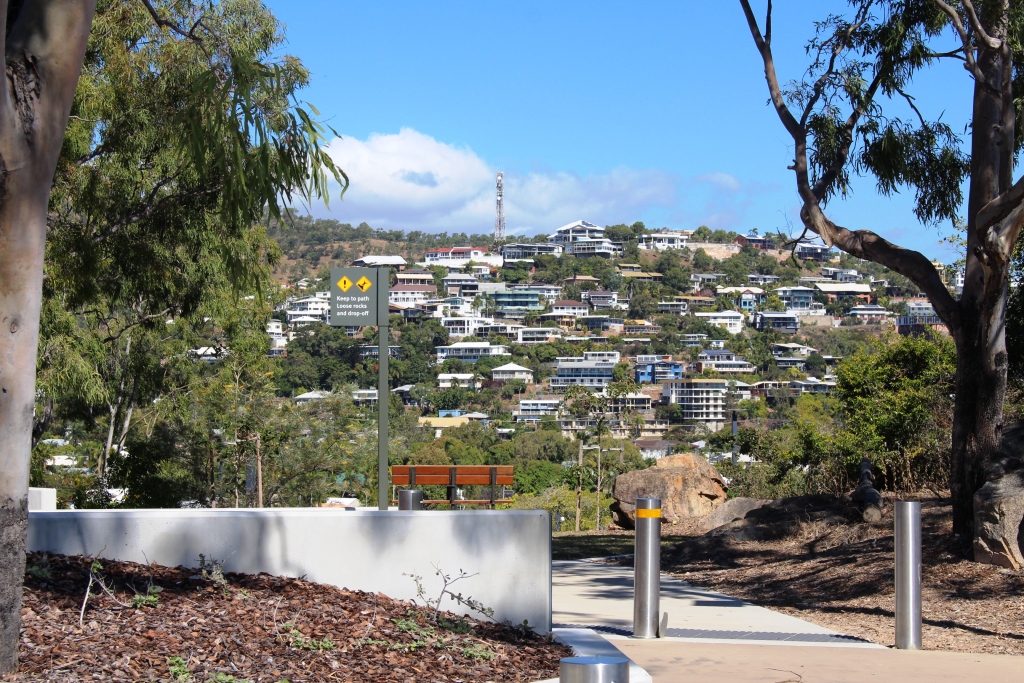
Hill side homes with views over Magnetic Island

Hill side homes with views over Magnetic Island

It took us two attempts to reach the summit of Castle Hill. The first attempt was thwarted by the phone call that confirmed our appointment with WO Hema at the military museum. We needed to find a place to turn around on the narrow and steep road to return to earth to keep our appointment. We only found turning space a couple of hundred meters from the top.


Our second attempt was later in the day, as sunset was approaching. We then discovered the extent to which residents of Townsville use this rocky elevation for exercise. The participants in this activity are mostly young and female but the slim black tighted majority

Misting station at the summit of Castle Hill

Misting station at the summit of Castle Hill

are interspersed with the not so slim, older men with looks of grim determination on their faces, the odd younger male on a bicycle. Young mothers with children in pushers were making the climb, some accompanied by young children on foot.

The Council has installed what could best be described as a misting booth at the summit so that hot climbers can cool themselves
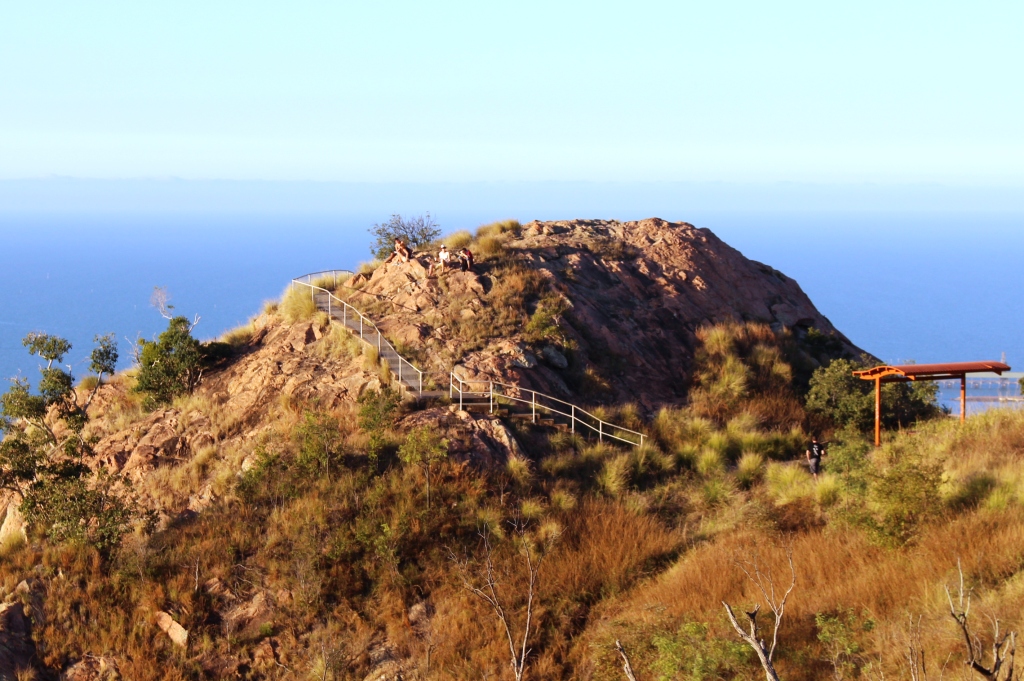
Climbers resting as they wait for the setting of the sun

Climbers resting as they wait for the setting of the sun

at the end of the climb. It is not greatly used on a winter afternoon but probably very popular in hotter weather. Some climbers wait to get their breath back, in tranquil solitude or small groups, before starting down again. Others occupy one of the many vantage points to watch the sunset.

Our most northern point on the coast this trip was Ingham. We stayed for three nights so that we
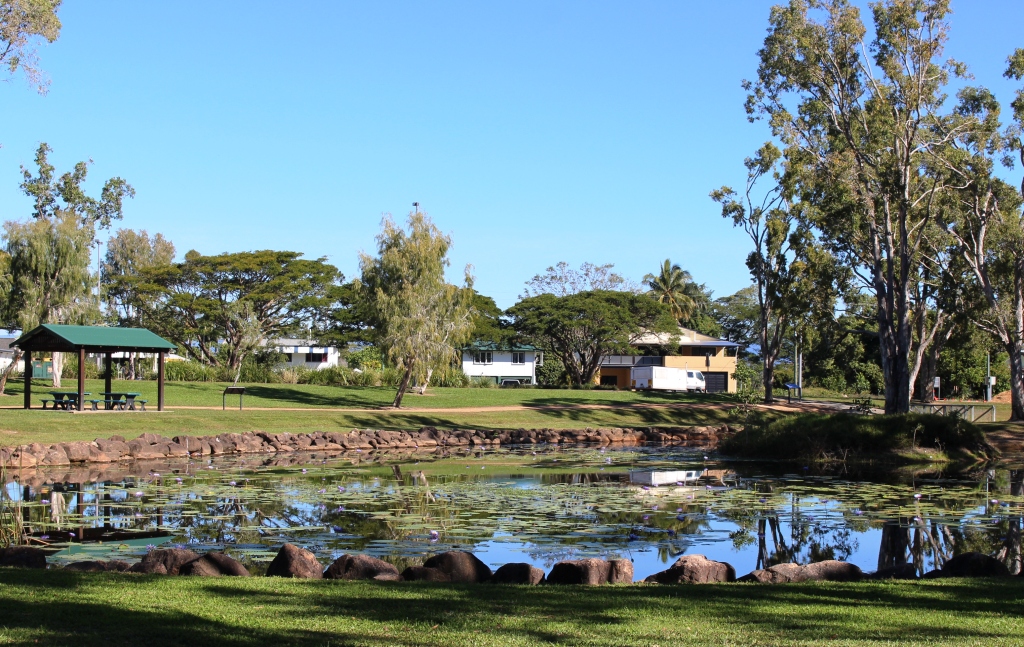
Ingham's Tyto wetlands are worth a visit

Ingham’s Tyto wetlands are worth a visit

had time to explore the mountains of The Great Dividing Range. This spine that runs the length of our east coast is never far inland in North Queensland. But first we used the afternoon of our arrival to take the drive to Lucinda, a small town adjacent to the southern tip of Hinchinbrook Island, to see the six kilometer long bulk sugar loading jetty.
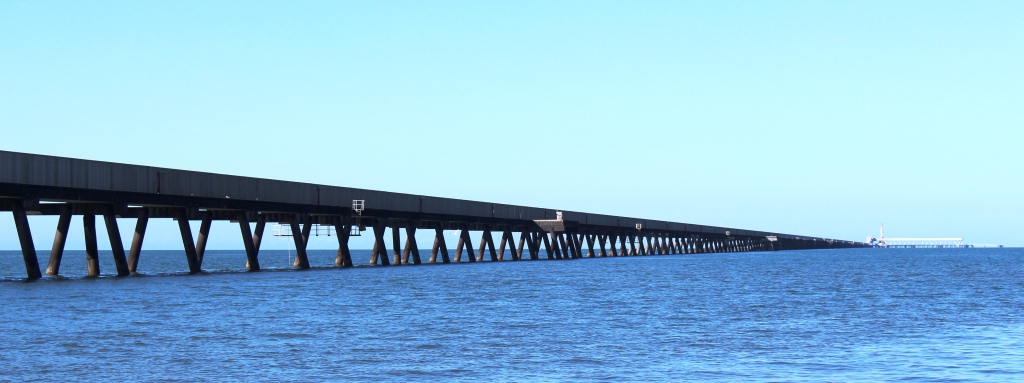
The six kilometre jetty seems to almost reach the horizon

The six kilometre jetty seems to almost reach the horizon

It was a beautiful afternoon, warm with a light breeze. It is not possible to walk along the jetty, which is really a huge conveyor belt with a maintenance road on top, but we walked around the adjoining park, stopping to talk to other strollers or to watch workers replacing the roof of one of the bulk sugar terminal
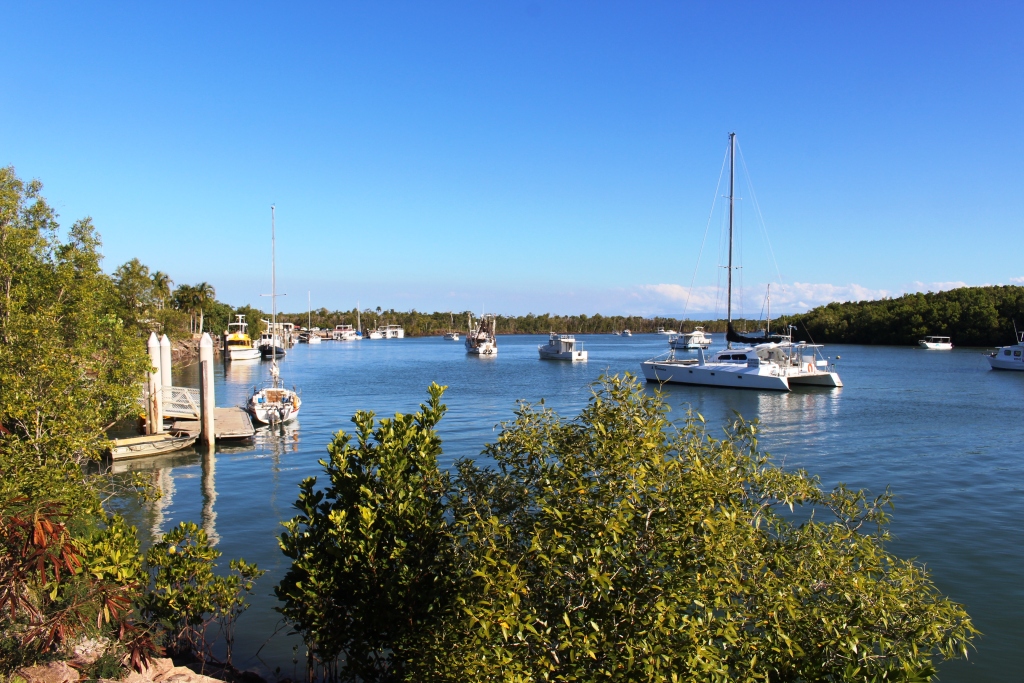
Boats at anchor at Dungeness

Boats at anchor at Dungeness

buildings. After driving the short distance to the neighboring town of Dungeness we refreshed ourselves with a restoring iced coffee as we enjoyed the view of the rugged peaks of Hinchinbrook.

The main reason for our visit to the area, apart from our search for warmth, was to visit Wallaman Falls. For a water fall to be worth visiting, you need water. Last time we were in the area, dry weather had reduced to flow over the falls to little more than a trickle. Current flows are sufficient for a good show.

The full view of Wallaman Falls

The full view of Wallaman Falls

Wallaman Falls, at a straight drop of about 230 meters, is the longest drop in Queensland. To get there you drive about 50 km west of Ingham, park in the area provided, then walk about 100 meters to the viewing platforms and there are the falls in all their magnificence.

The water tumbles over the edge of a precipice in a plunge that is unimpeded until it creates a continuous explosion of water on the rocks of the continuation of the stream into which it falls. Nature has dictated that the falls face about north east so are directly lit by sunlight for most of the day. The rays of the sun create rainbows in the spray. The rainbows move up and down the column of water, changing with the position of both sun and viewer. At times, from a particular position you can watch two rainbows move together to become one.
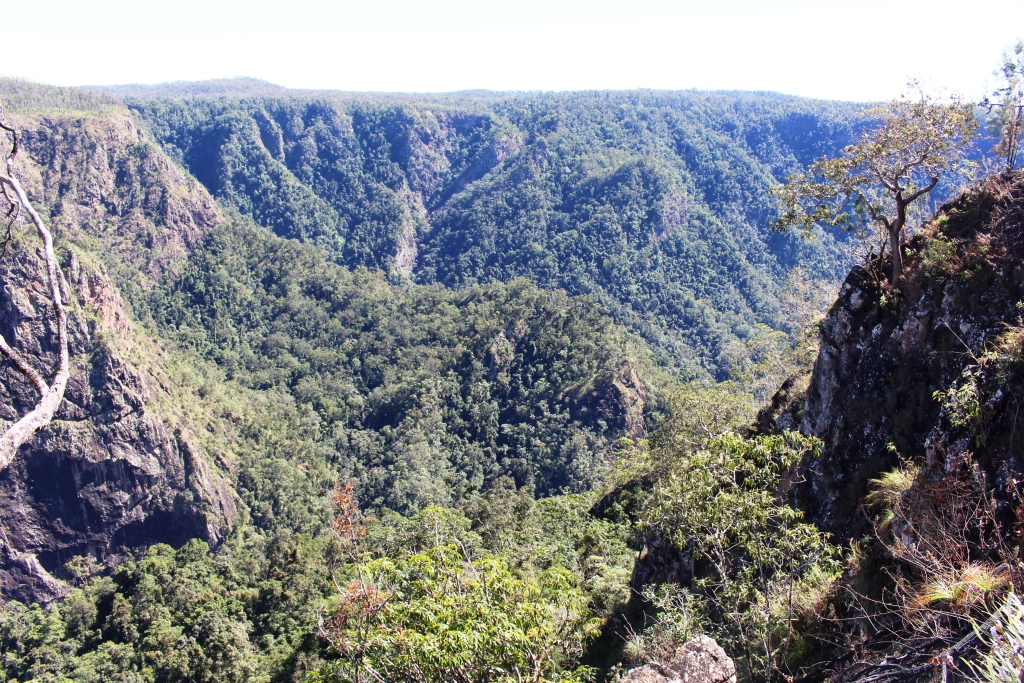
The gorge down stream from Wallaman Falls

The gorge down stream from Wallaman Falls

Those with much more energy than I possess can descend by a steep but well formed path to the foot of the falls and no doubt, from that changed vantage point, can view more rainbows in the spray. But the return journey is a kilometer multiplied by two. That requires a lot of energy.

The first 30 km of the drive is through cane fields and grazing
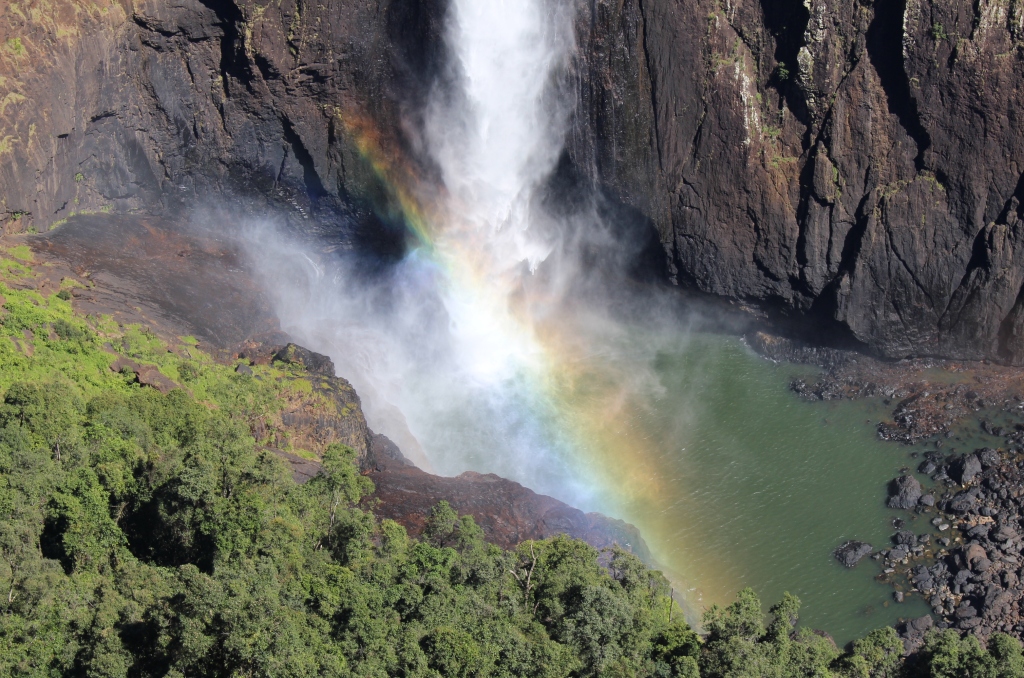
The rainbow in the spray

The rainbow in the spray

country. The final 20 km is up the mountain. The road is a good width, but steep and winding for most of the way. Only about 5 km remains unsealed and roadwork in the area suggest that this will soon be fixed.

On our way home we encountered the unexpected! We had slowed as we approached a creek crossing because of the rough surface and noticed that an approaching vehicle had pulled to our side of the road and stopped. So we stopped too. And there, walking casually along the road towards us was a fully grown Cassowary. It was in no hurry and walked within a meter of my open window. Then a third car approached, in a hurry, and the bird was gone, frightened back into the scrub.
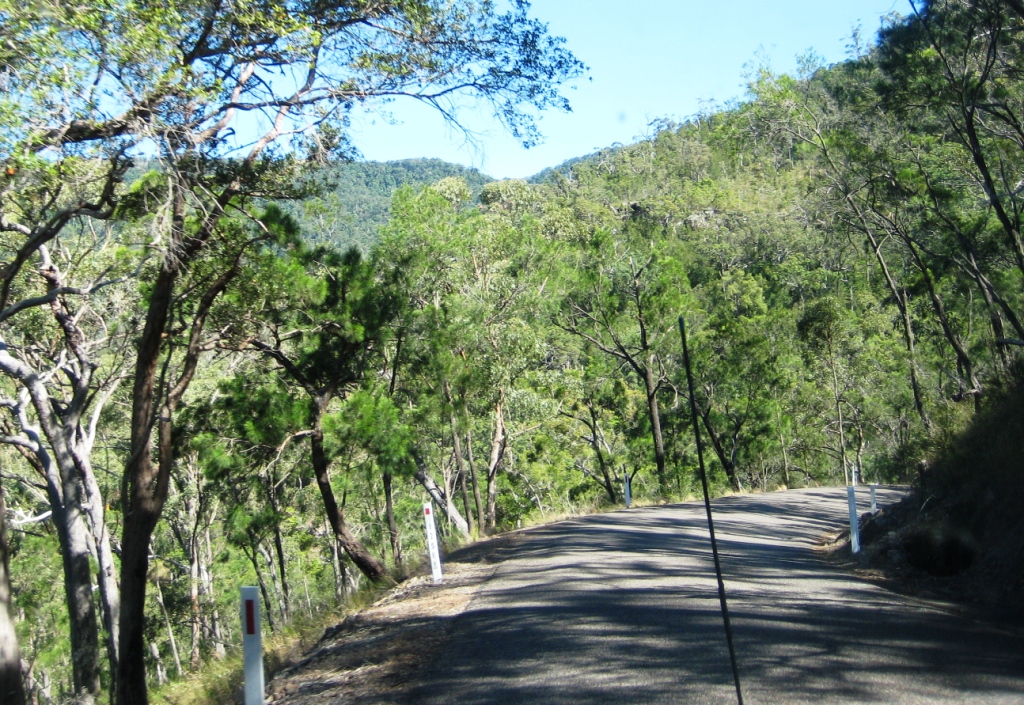
A sample of the narrow Mt Spec Road

A sample of the narrow Mt Spec Road

The following day we travelled about 40 km south on the Bruce Highway and drove up the Paluma Range to the mountain top town of Paluma and on a further 12 km to the Paluma Dam. We had tried to do this a couple of years ago but were thwarted by cloud over the mountain. About a kilometer from the top we had encountered thick fog. This time the sky was blue, without a cloud in sight.
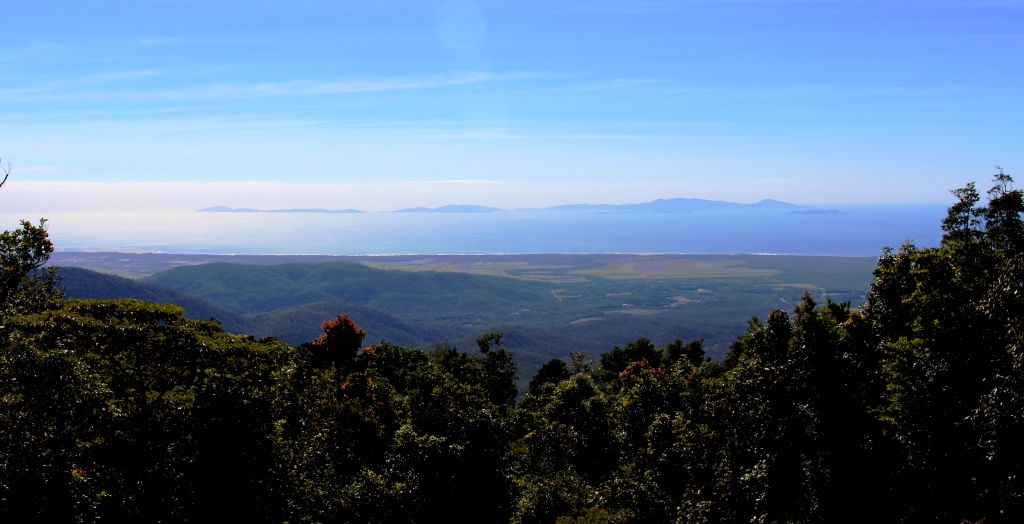
The view from near Paluma

The view from near Paluma

The scenery is not of the standard of the Wallaman Falls drive but the lookout at Paluma provides sweeping views of the coast and off lying Islands, of which Palm Island is the most dominant.

Access is via Mt. Spec Road, which is interesting in its own right. Built during the depression, the construction was accomplished mainly by manpower with little mechanical assistance. The workforce was substantial, probably because men were more readily available than machines. The road climbs and twists its way to the summit providing tempting glances of the view to be seen from the lookout at the top.

Below the bridge over Little Crystal Creek

Below the bridge over Little Crystal Creek

Certainly the most charming spot on the road is the bridge that crosses Little Crystal Creek. It is a single arch structure of concrete but beautifully faced with stone in the manner of so many historic bridges in Australia. But if you simply drive over it you miss the best. For where it spans the creek waterfalls tumble into rock pools that make great swimming holes on warm days. It is a magic place. The amenities block at the picnic area even has a change room.
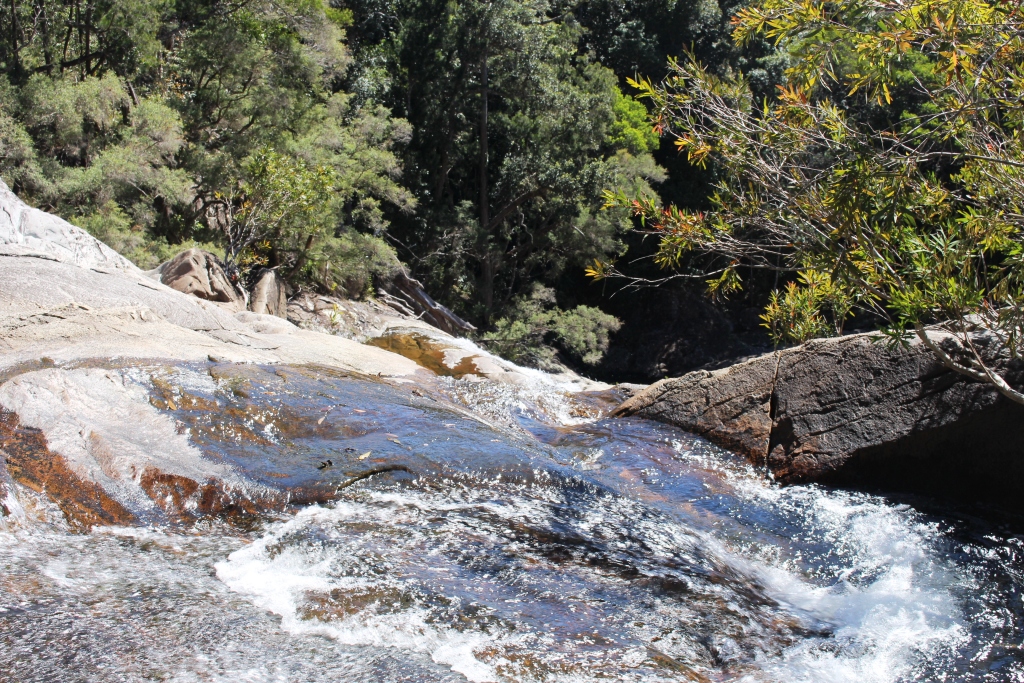
At the top of Birthday Falls

At the top of Birthday Falls

The drive to the dam is through rain forest and over mountain ridges on a narrow gravel road. About halfway between the town and dam a clearing in the bush provides parking for those who go on the 500 meter walk to the top of the Birthday Falls and perhaps the 500 meter scramble to the bottom. We chose the former and while the view from the top is probably not as good as from the bottom you still get the idea of a stream of water plunging into a valley far below.

The waters of Paluma Dam

The waters of Paluma Dam

The dam is part of Townsville’s water supply but is also a favorite camp site for locals. We met a surprising succession of vehicles as we returned down the range. Paluma is probably something of a weekend retreat for Townsvillians and it was Saturday afternoon. We completed the day with a stop at the Frosty Mango for an ice cream as we returned to Ingham.
Wandering Nomads & Military Museums

During the four days spent in Mount Isa we had discussed our route to reach home. The idea of going south seemed attractive until the weather forecast suggested rain just at the time when we would have been in unsealed road territory. Morning temperatures were looking a bit low further south, so staying north was an easy decision.

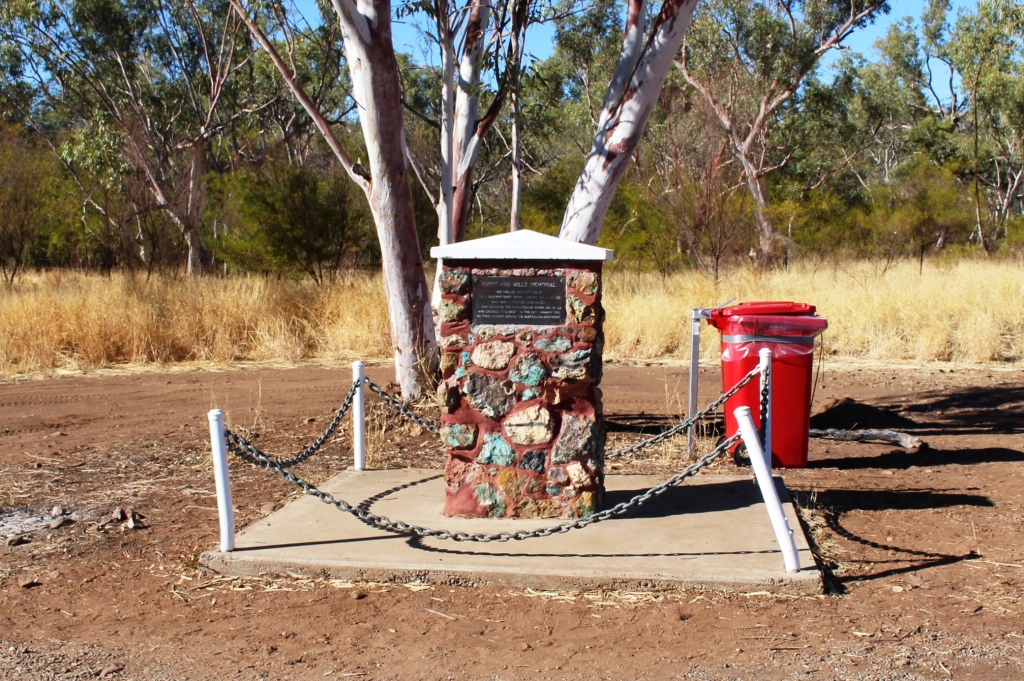
Our path crossed that of explorers Burke & Wills on their journey across the country

Our path crossed that of explorers Burke & Wills on their journey across the country

The obvious choice was to travel east. Townsville is about one thousand kilometres east of Mount Isa. We did the distance in three easy days, with overnight stops at Richmond and Charters Towers. This was the first time we had covered the full length of the Flinders Highway in one journey, although we had travelled most of it at different times. The only town that we had not previously visited was Julia Creek.

It was Sunday morning and the town was surprisingly active. Two supermarkets were open and several caravans were parked in the main street. There was a queue for service at the roadhouse when we bought fuel.

Part of the main street of Julia Creek

Part of the main street of Julia Creek

Caravans and motor homes are everywhere at this time of year. Towns like Julia Creek are awake to the tourist potential and are taking action to encourage travelers to stay a while. Gray nomads are a responsive target market. Not all are doing “the big lap” and those that are aren’t always in a hurry. Many from Victoria, South Australia and the southern regions of New South Wales are simply looking for a place in the sun.

Self contained RVs in residence by the waterhole near Julia Creek

Self contained RVs in residence by the waterhole near Julia Creek

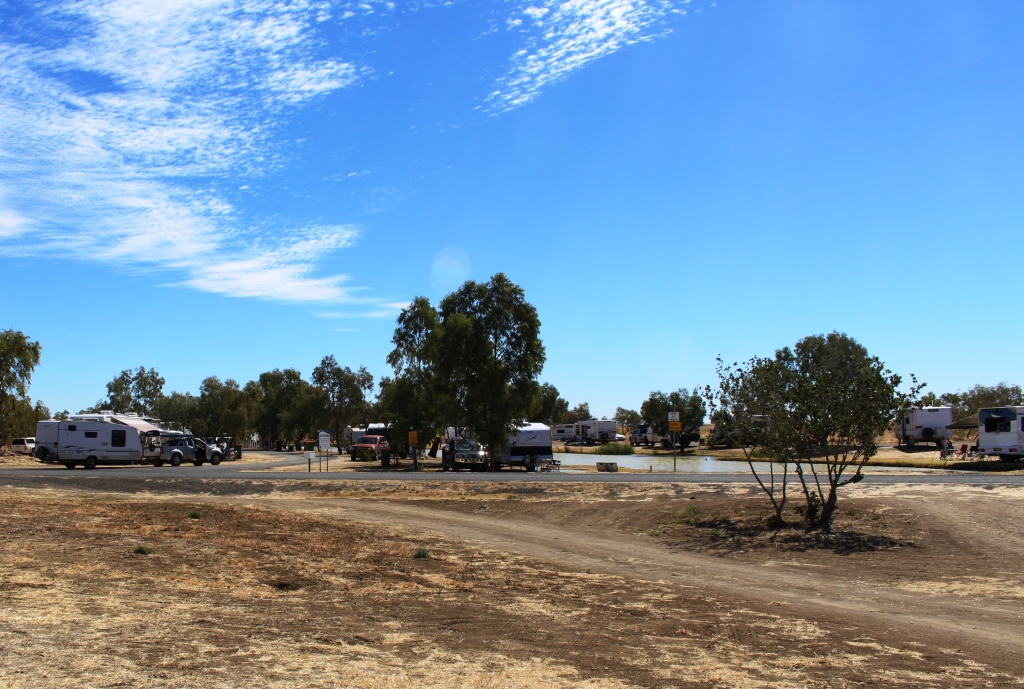
Just past Julia Creek, by what appears to be a permanent waterhole, the council has planted an extensive grove of trees, which are thriving on irrigation. We nearly bogged when we drove between them to find shade for a lunch time stop. There is an extensive camping area where there is no charge for staying, but a camp host is proved to maintain order. No other facilities are provided so the area is most suitable for fully self contained vans, but there are plenty of those on the road. There were about 30 vans and motor homes set up there with more arriving as we lunched.

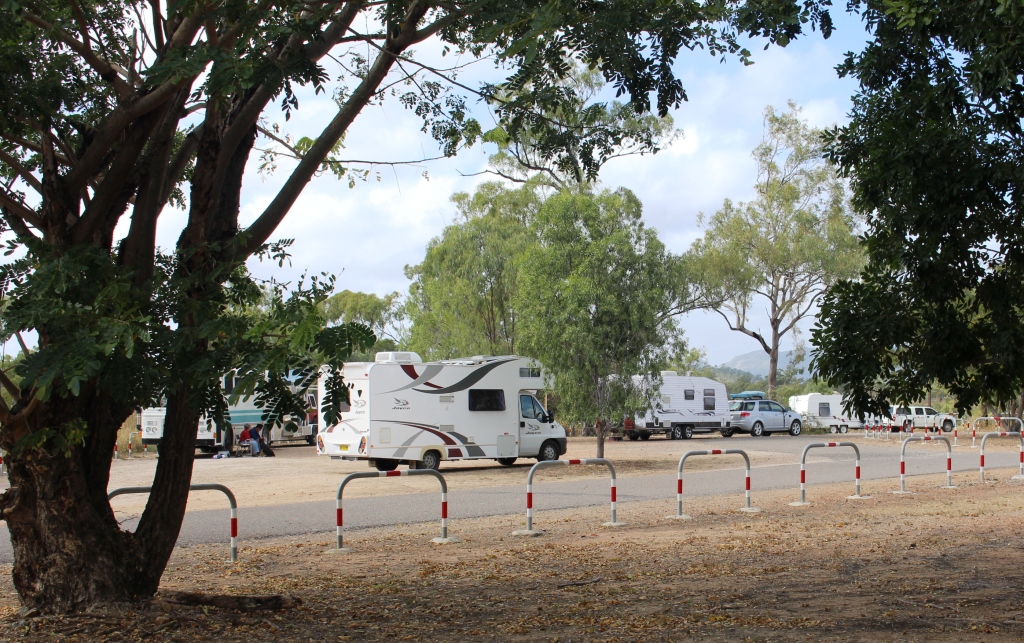
Free camping RVs at Reid River rest stop by the Flinders Highway

Free camping RVs at Reid River rest stop by the Flinders Highway

This was only one example of modern gypsy camps. On our way out from Lawn Hill we crossed the Gregory River at Gregory Downs. The river banks are high and the bridge is above flood level. It provided a great view of what can best be described as a caravan village. Gregory Downs is serious distance from anywhere but it is the nearest free camp to the end of the sealed road so the conventional vans and motor homes stop there for a day or three to do a day or overnight trip to Lawn Hill National Park and Adel’s Grove, or just spend the time watching the river flow by. There are a lot worse things to spend your time doing!

Travelling east, the Flinders Highway starts at Cloncurry and its surface is a bumpy old affair. Not a very good tribute to the great explorer in whose memory it is named, I thought, “There needs to be a concerted effort to bring the highway up to a better standard”. As they say, you need to be carefully of what you wish for. Not too far along we came to the first of many automated red lights. You know the type? A two wheeled device with solar panels, an antenna and a closed circuit camera? One side of the road was closed and the traffic from each direction had to take turns using the remaining side while work progressed on the closed side. For the remainder of that day and the next we encountered over twenty of them, often six or more in quick succession and most at least a kilometre long. They totally blew my ETA at the next caravan park out of the water.

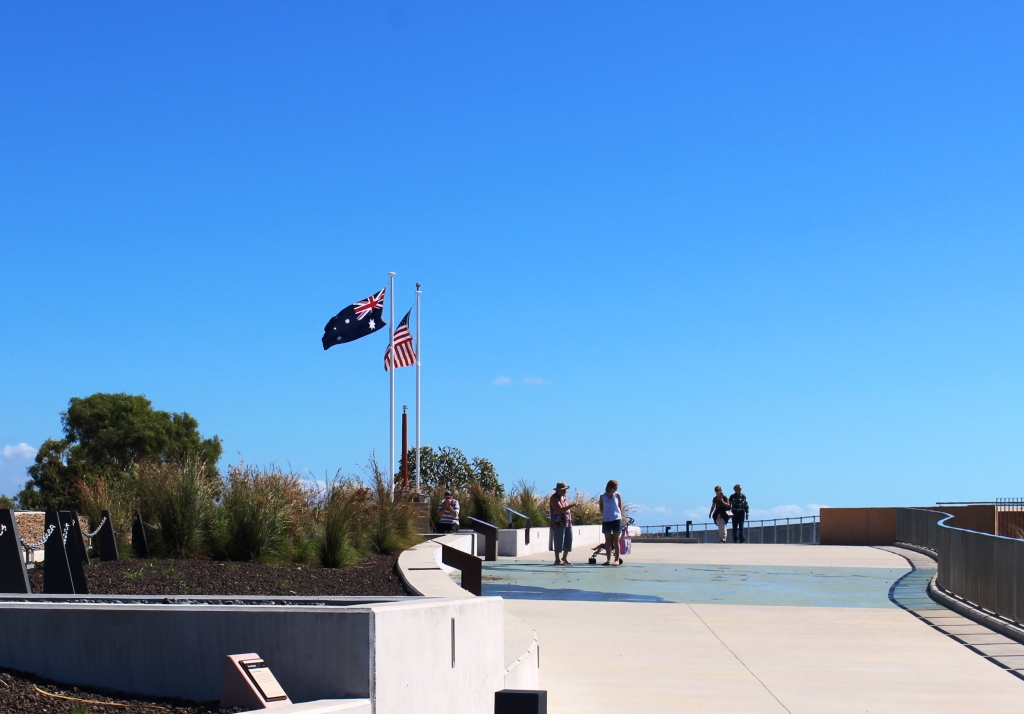
The memorial atop the historic Kissing Point Artillery Battery

The memorial atop the historic Kissing Point Artillery Battery

The sun was shining in Townsville and we rediscovered humidity. But a pleasant breeze was blowing. We spent the remainder of arrival day on camp duties. But we had come to Townsville, in part, on a mission.

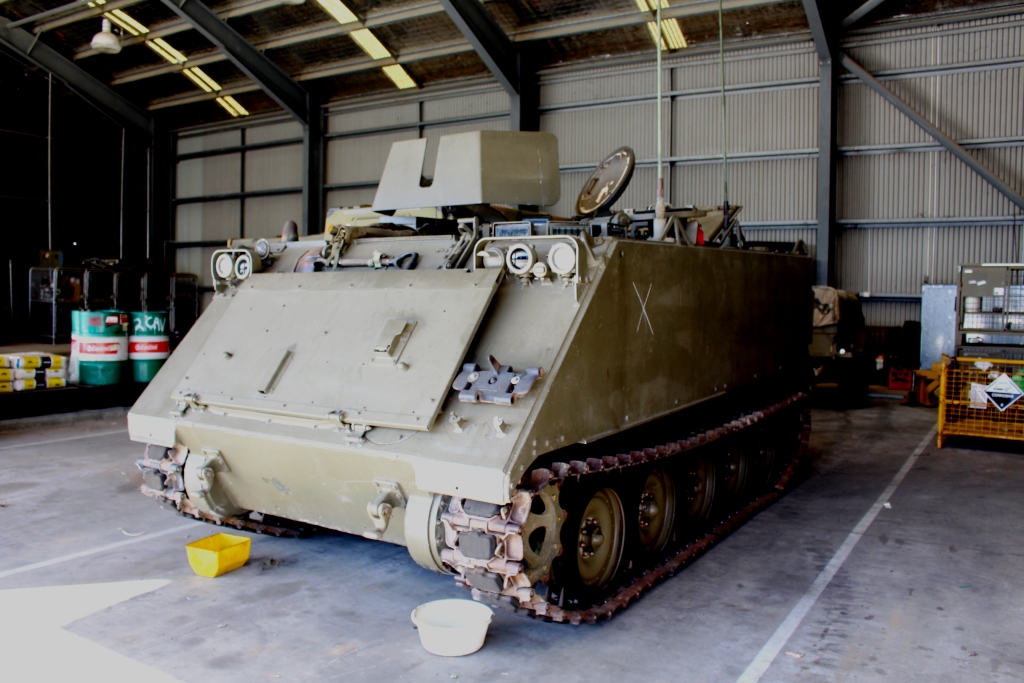
Ron, our next door neighbor is a Vietnam veteran. He was an Armored Personnel Carrier (APC) driver and part of the first Australian force to be deployed there. Ron was injured in action in Vietnam and has recently suffered a stroke. He has lost a great deal of his mobility but none of his fighting spirit.

Laravack Barracks covers a large area at the foot of Townsville's Mount Stuart.

Laravack Barracks covers a large area at the foot of Townsville’s Mount Stuart.

At a Christmas function at our units last year he told me that his old APC was now at Lavarack Barracks at Townsville and was available for viewing to the general public. I decided then that I would like to see it. Our changed plans would take us through Townsville so here was the opportunity.

Ron's Armored Personnel Carrier

Ron’s Armored Personnel Carrier

We started our search at the gate house at Lavarack Barracks but no one there knew about it so they referred us to the military museum at the northern end of The Strand, that ocean side boulevard that runs

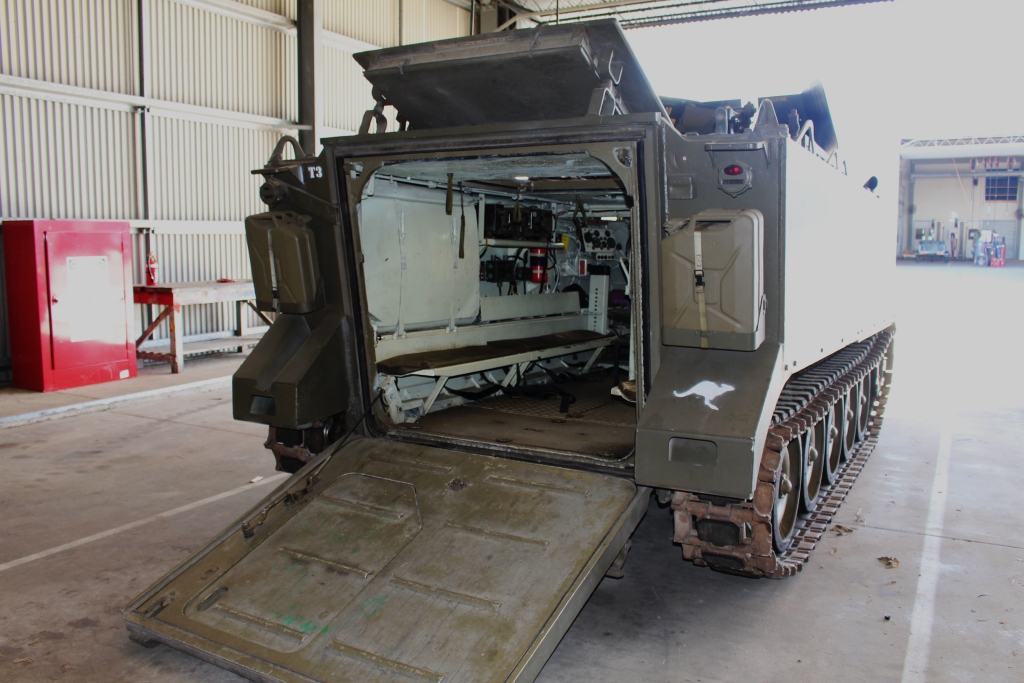
APC with rear ramp down ready to load troops

APC with rear ramp down ready to load troops

north from the CBD and gives such magnificent views of Magnetic Island. It was here that we struck pay dirt. This museum is worth a look in its own right. It covers from the period from the Boer War to modern engagements such as Afghanistan, but mainly from the perspective of Townsville as a garrison city. The restored Kissing Point Fortress is right next door.

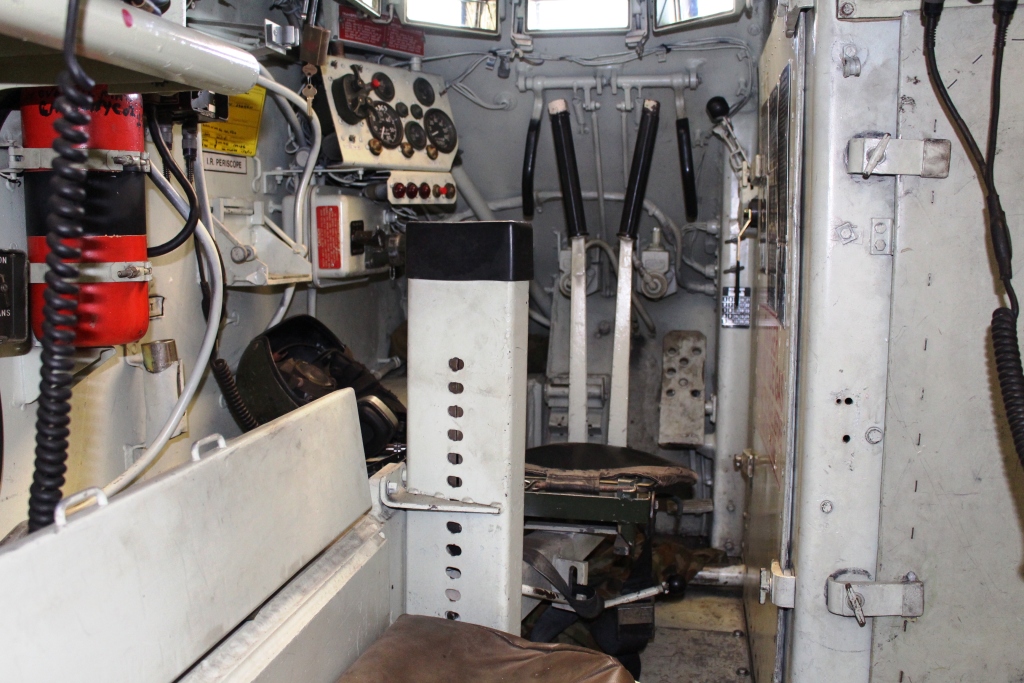
APC drivers position and steering levers

APC drivers position and steering levers

The very helpful volunteers at this museum gave us a name and mobile number for a the curator of a museum for the armored regiment that is within the confines of Lavarack Barracks. Soon we had an appointment with WO2 Rocky Hema who signed us in and took us to the museum area where equipment with historic significance is stored. There we found Ron’s APC. It was opened up for us so we were able to climb inside and have a real good look.

I asked Warrant Officer Hema why this particular APC had been preserved. He told us that it had carried the officer in charge of the convoy and that with different crew had played an important role at the battle of Long Tan. He then took us to see the more conventional part of the museum where we saw a photograph of a young and handsome Ron Jose.

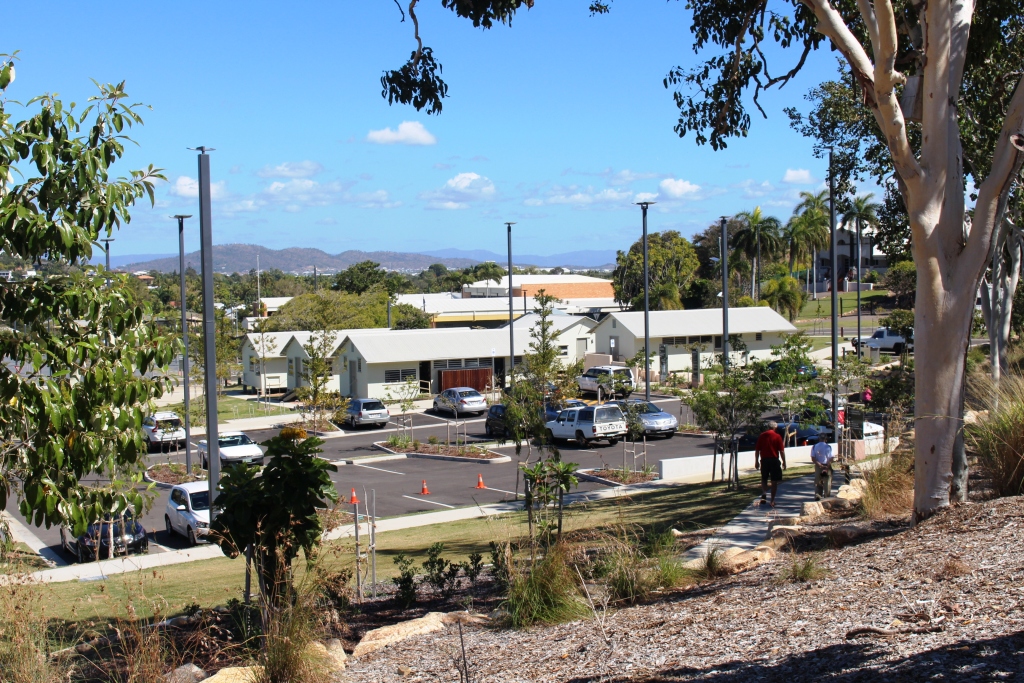
Part of the military museum complex at the northern end of Townsville's Strand.

Part of the military museum complex Jezzine Barracks on Townsville’s Strand.

This regimental museum will only be at Lavarack Barracks for another two years, after which it will be moved to a new permanent home at Puckapunyal, near Seymour in Victoria, a place familiar to me from my brief encounter with National service Training over 50 years ago. We took photos of Ron’s APC and sent one off to him attached to a text message. The rest we will pass on when we arrive home.

Another Change of Plan

When we bought our current van we had warmer climes in mind, so we didn’t pay much attention to heating. Cooling was more important, so air-conditioning was fitted. Heating is now provided by either aircon on reverse cycle or the $20 fan heater from Bunnings. The $20 heater wins hands down.

As a consequence of about 10 consecutive mornings of around zero degrees, and that our travel plans, if followed, would require several nights away from power, a new plans was called for. We were already on Plan B so Plan C was essential to our cumfort. The answer was a no brainer, of course.  Go north!

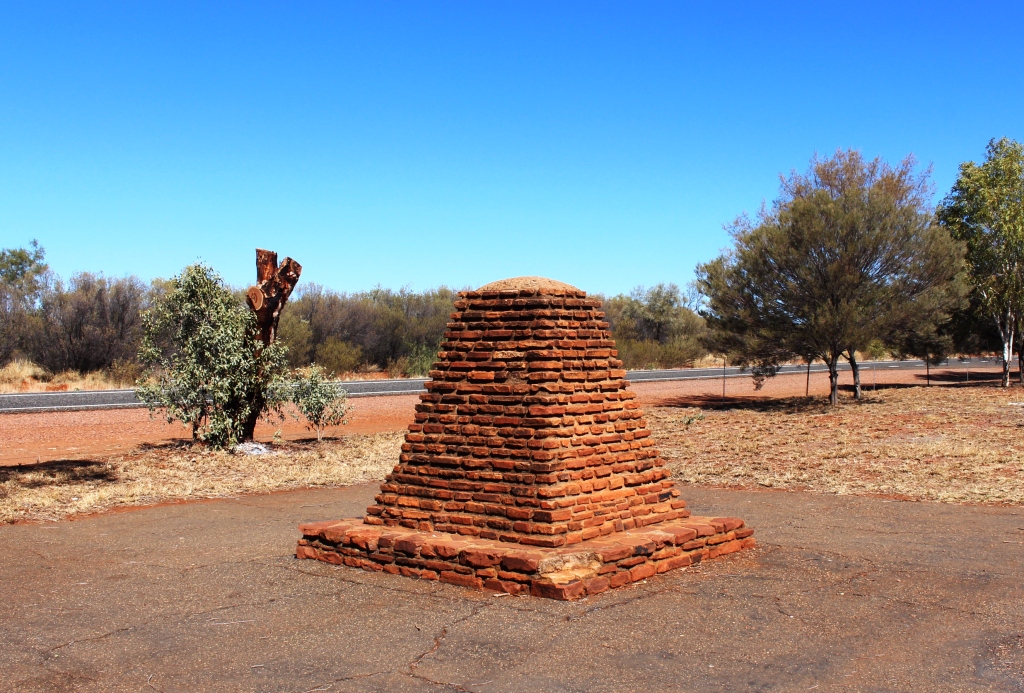
A monument to John McDowell Stuart beside the highway north from Alice Springs. Reminders of Stuart's explorations are scattered through the area

A monument to John McDowell Stuart beside the highway north from Alice Springs. Reminders of Stuart’s explorations are scattered through the area

Research on the Weather Channel app indicated that to drive 500 km north to Tennant Creek would improve the minimum temperature by about 10 degrees. Alice Springs is quite elevated. Most mornings it felt like it was above the snow line.

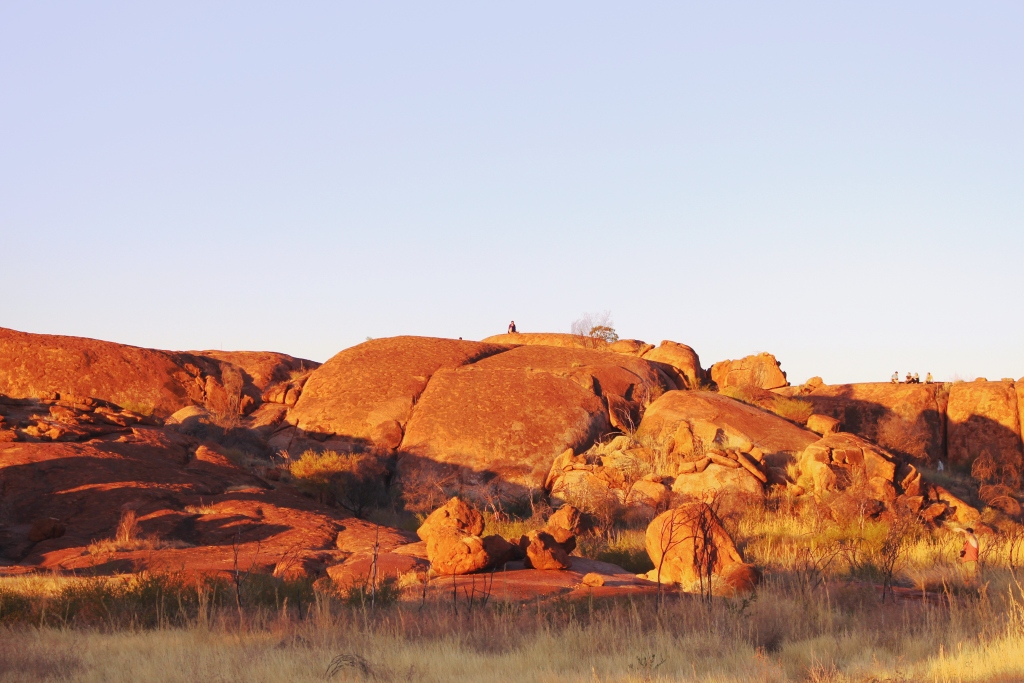
A solitary sunset watcher on one of the highest Marbles

A solitary sunset watcher on one of the highest Marbles

So we headed north. Last time we departed Alice Springs heading north we were travelling in company with friends who had a need to return to Brisbane, so we put in a couple of long days with them. This departure was more leisurely.
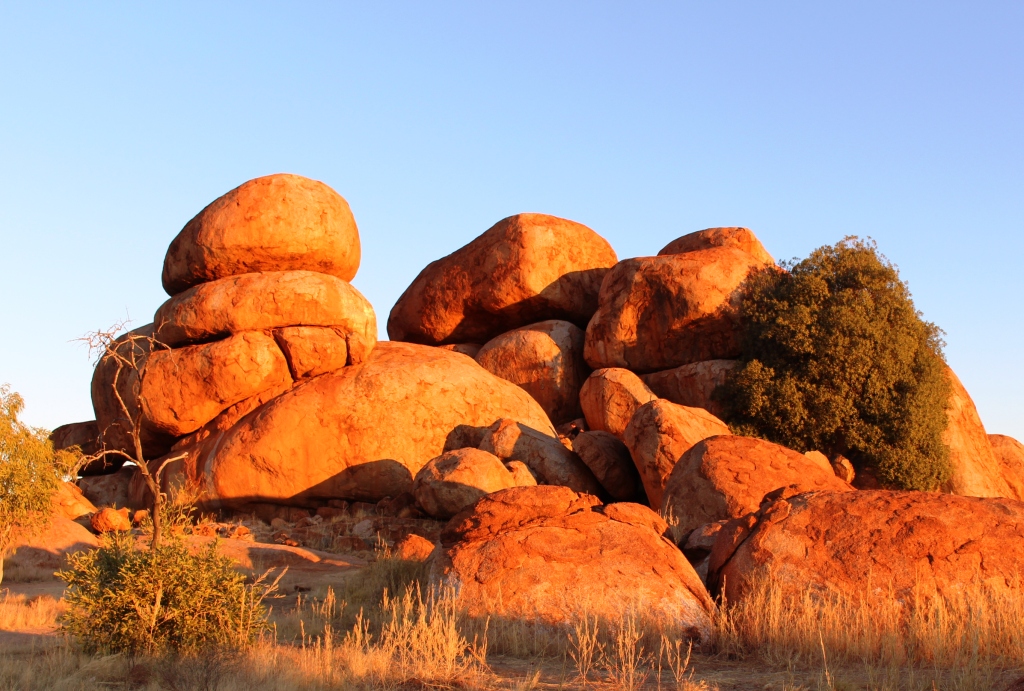
Piles of "marbles" lit by the setting sun

Piles of “marbles” lit by the setting sun

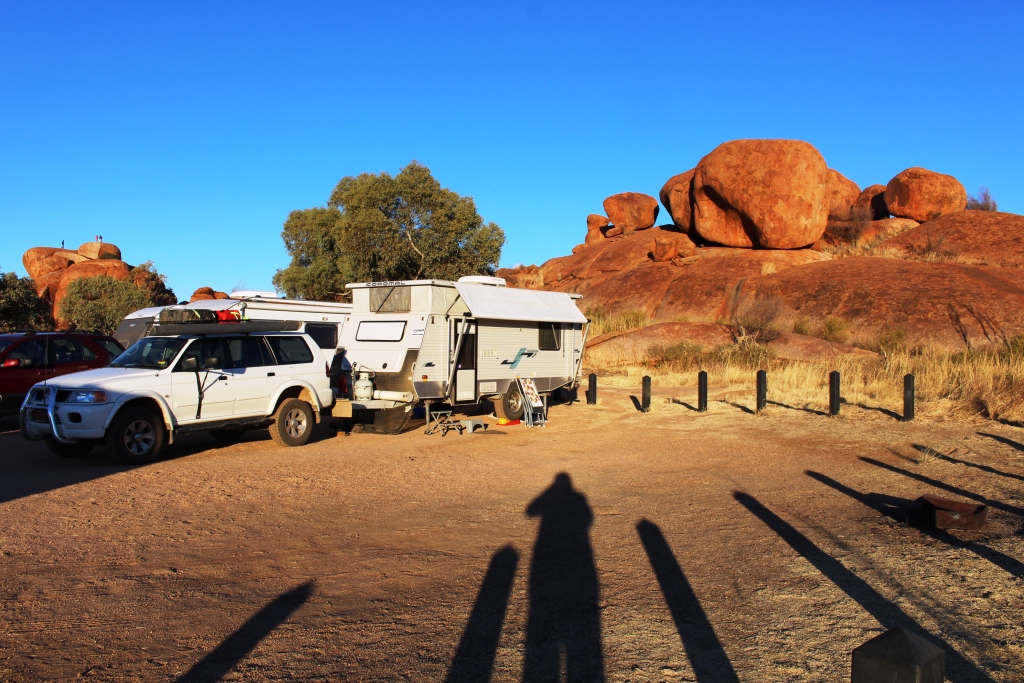
On an impulse and because of the promise of higher minim temperatures, we decided to try for a space in the camping area at the Devil’s Marbles. We were successful, getting the second last

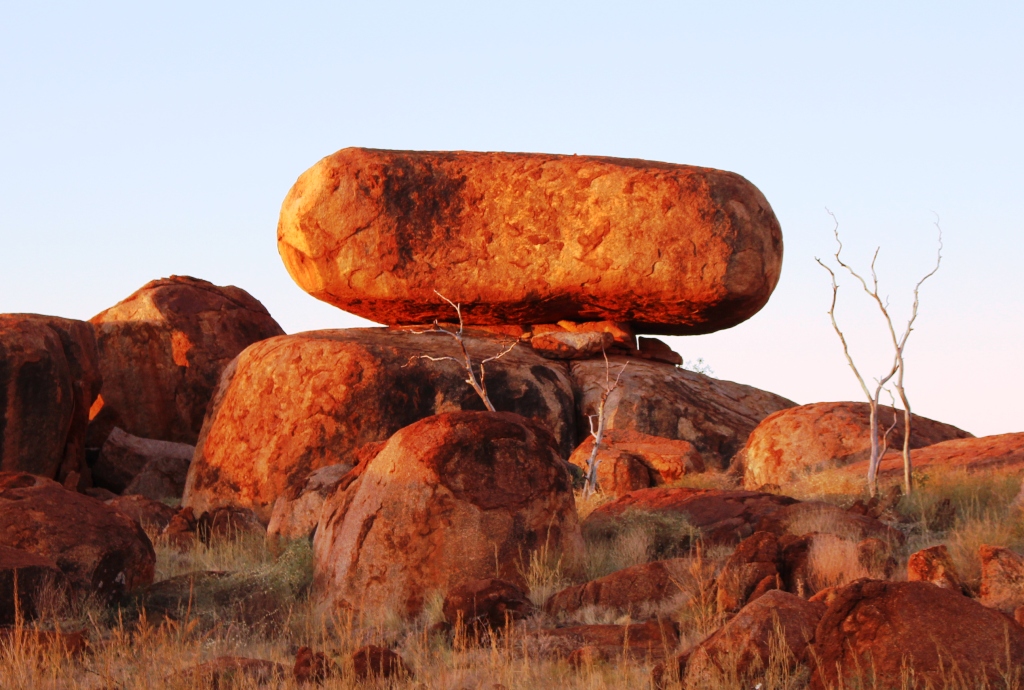
A cap stone not likely to fall any time soon

A cap stone not likely to fall any time soon

spot from the far end, by a nose. We were attracted to the Marbles by folk who wax lyrical about the wonder of sunrise and sunset light on the unique naturally rounded rocks.

See! I was up early.

See! I was up early.

Once again my imagination was missing. But having now been there, I think much of the appeal is to those with younger bodies who climb to the vantage points on the highest marbles to watch the sunset. Noticeably fewer climbed to see the sun rise. Perhaps about 8 degrees and a cool breeze had something to do with it.

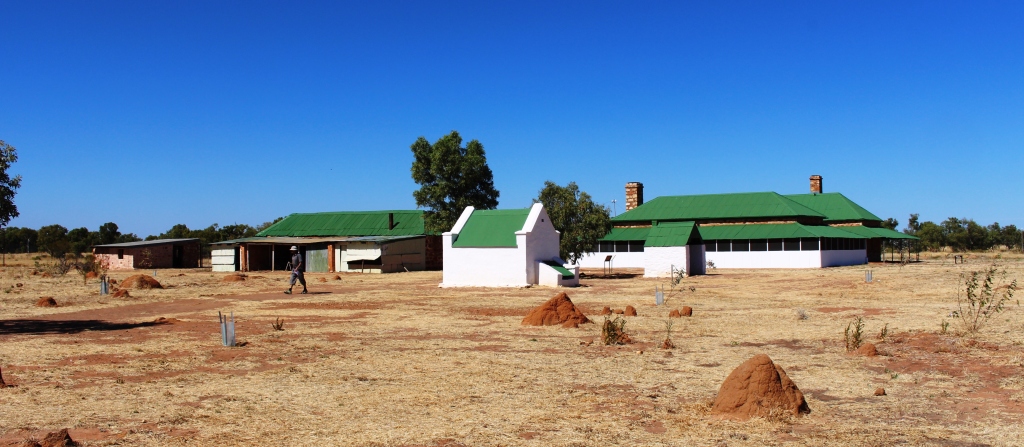
The old Tennant Creek Telegraph Station. The history of the Center is so involved with the Overland telegraph Line that reminders are everywhere

The old Tennant Creek Telegraph Station. The history of the Center is so involved with the Overland Telegraph Line that reminders are everywhere

Next day we started out across the Barkley Highway that crosses the Barkley Tableland. This was our second Barkley crossing this trip having crossed it further south via

The caravan parking area at Barkley Homestead

The caravan parking area at Barkley Homestead

the Donohue and Plenty Highways. About halfway across, at the junction with the Tablelands Highway, Barkley Homestead offers its services to the travelling public. It is a homestead no longer, but a roadhouse, superior in quality to many similar establishments in the area, and offering a full range of price competitive services. Even petrol prices were in line with those of Tennant Creek and Mount Isa, slightly higher, but reasonable

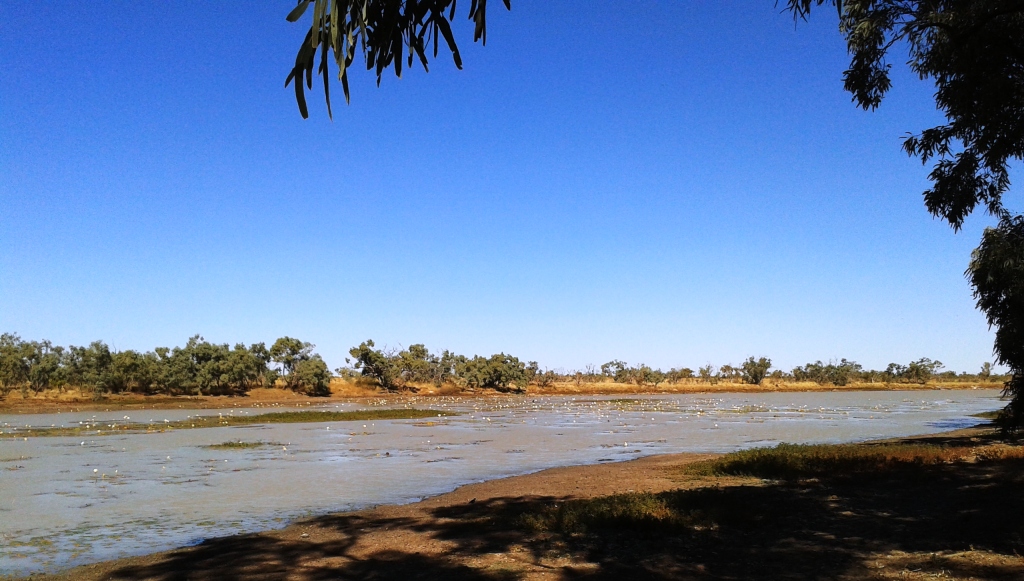
Water lilies on Camooweal billabong

Water lilies on Camooweal billabong

The next night was spent beside the Camooweal Billabong with a substantial number of Australia’s caravan owners. As a stopover for free campers the place is legendary. And with good reason! It hosts huge clumps of water lilies and a range of water birds. Of particular interest was a pair of pelicans doing a synchronized feeding dive as well as a pair of preening brolgas. But they are on video and not immediately available.

All this on the way to a return visit to Adel’s Grove and the Lawn Hill National Park.

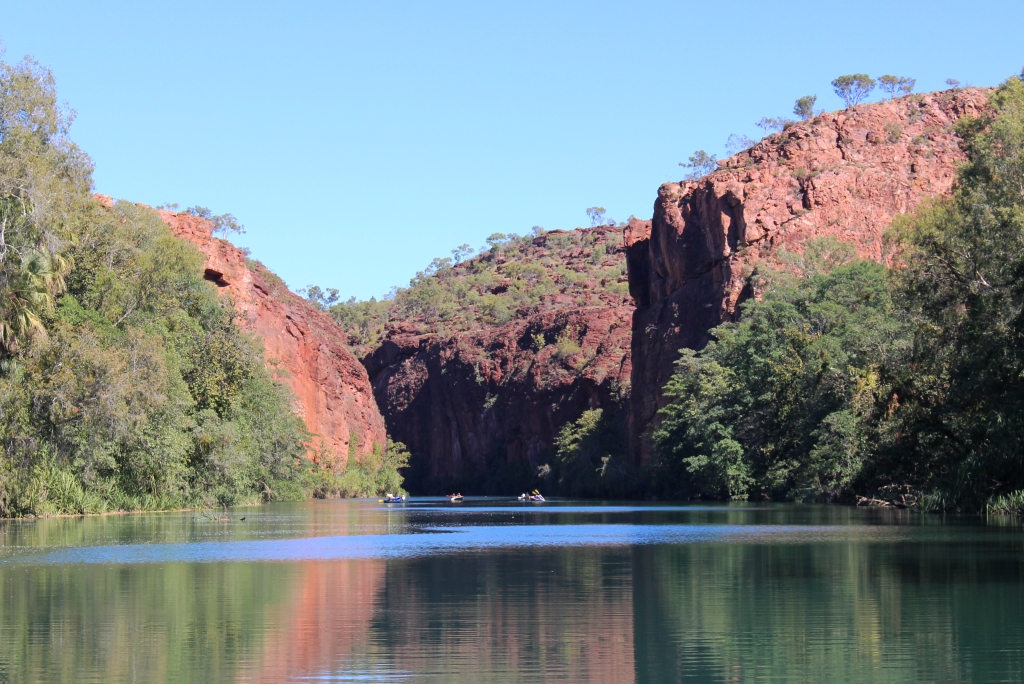
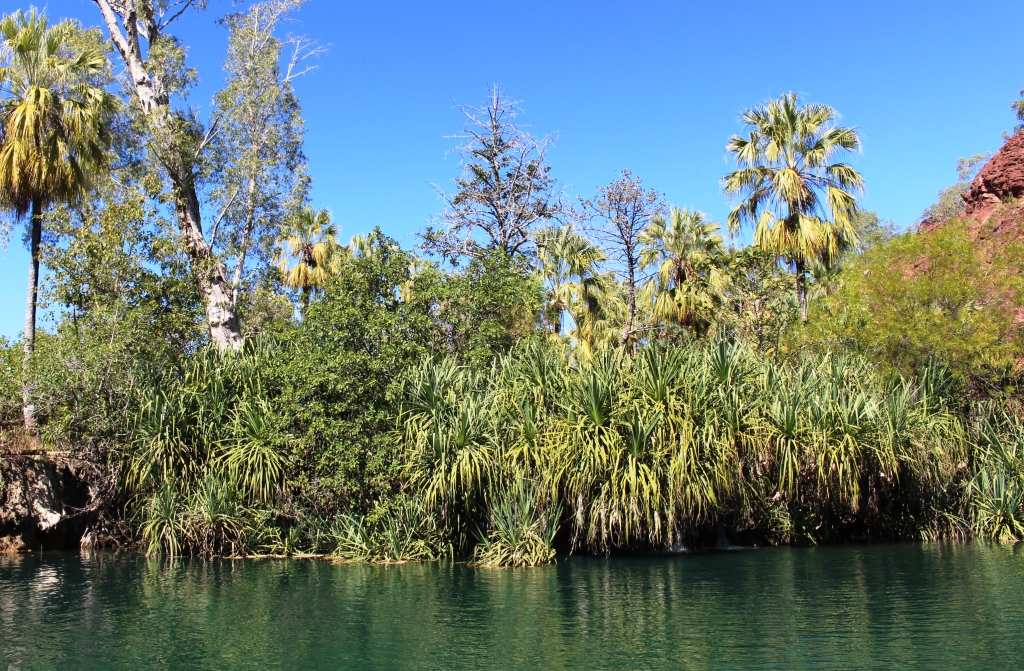
Tranquil waters of Lawn Hill Creek as it flows through the gorge

Tranquil waters of Lawn Hill Creek as it flows through the gorge

We first visited this natural gem four years ago as a follow on to our first visit to the Red Center. On that occasion we left the van at Burke and Wills Roadhouse and stayed in the cabin accommodation at Adel’s Grove. This time we went in from Camooweal. Of the total distance of about 290 km about half is gravel and rather rough in many places. That made for a slow and dusty journey with frequent oncoming traffic, speeding at the head their personal cloud of dust. A cross wind meant that our dust blew clear of the road while their dust blew into our path often totally obscuring our view of the road. And whatever has become of the once practiced courtesy of slowing down to reduce dust and flying stones.

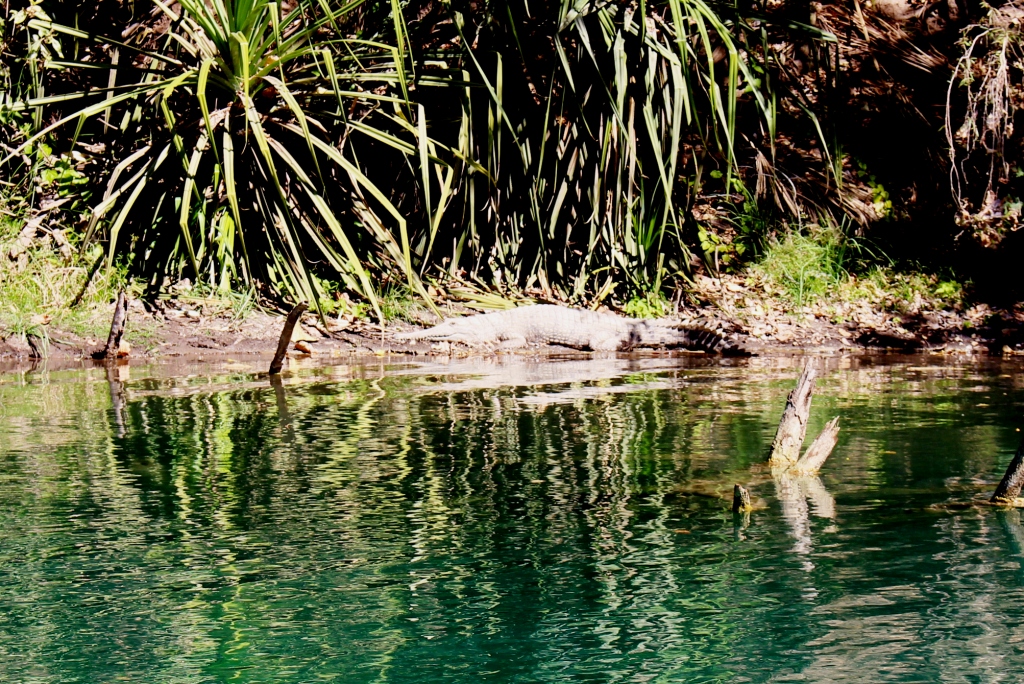
A local resident taking the sun

A local resident taking the sun

There are two choices for staying in the Lawn Hill area. NT National Parks have a camping area at Lawn Hill Gorge and Adel’s Grove offers a range of accommodation options. Adel’s Grove is located 10

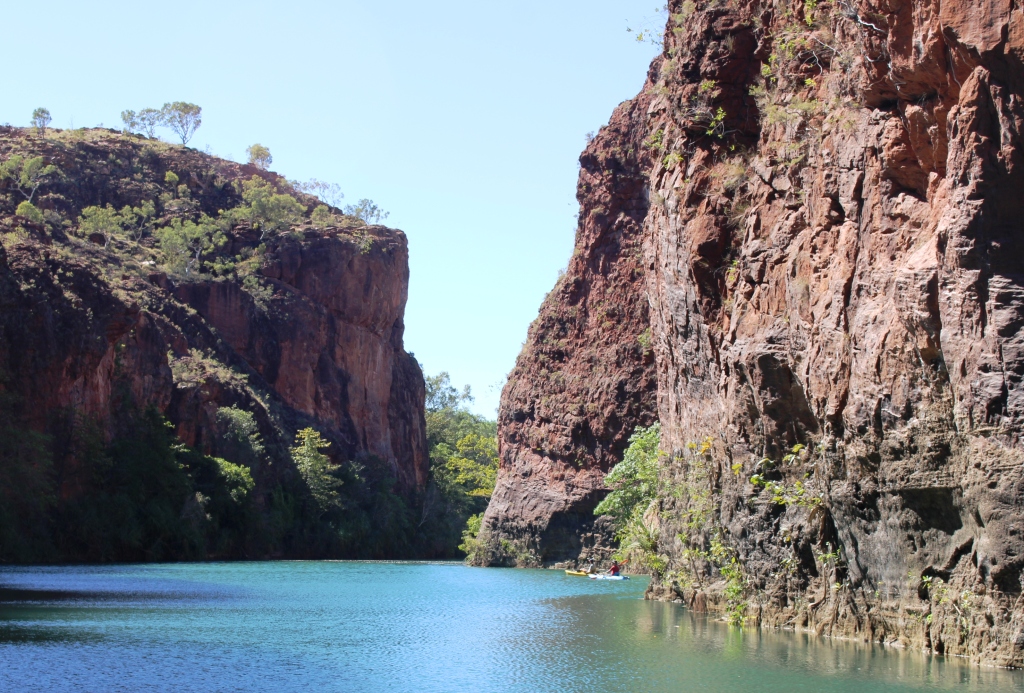
A natural barrier of calcium divides the lower and middle gorges

A natural barrier of calcium divides the lower and middle gorges

km before the gorge is reached and is our choice as a place to stay. When we were there it was also the choice of a large team of paleontologists who were there for a dig at the nearby Riversleigh fossil sight. So there was

Another view of the gorge

Another view of the gorge

not enough hot water to go around and the restaurant was booked out for the two nights that we were there.

But there are improvements since we last visited. A new amenities block is

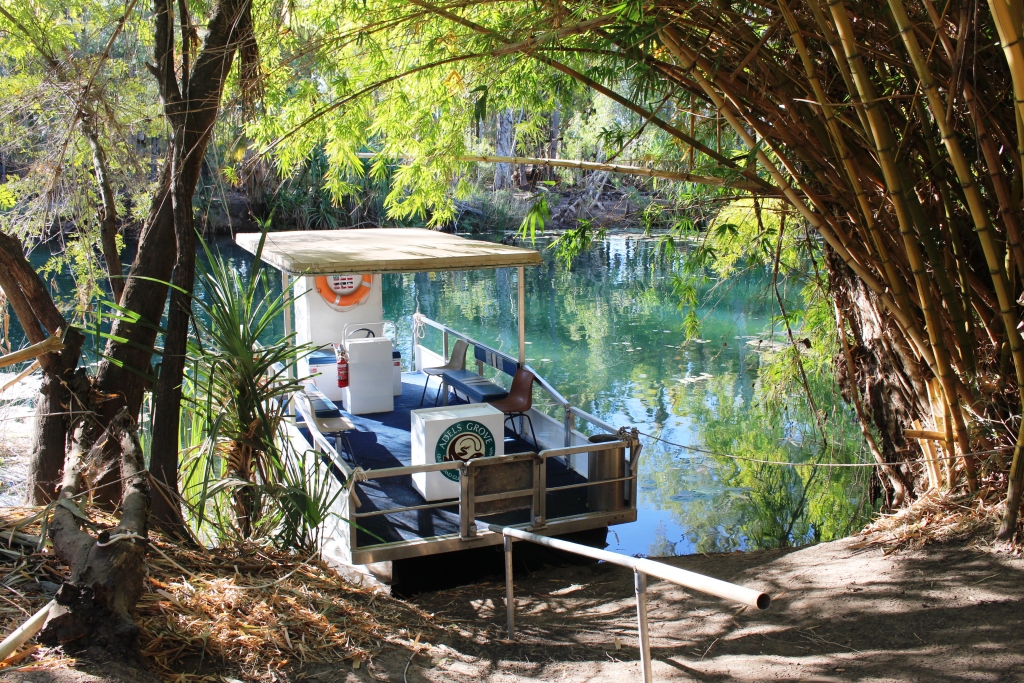
One of the two cruise boats moored in the creek near the resort

One of the two cruise boats moored in the creek near the resort

a great improvement and a take away shop sells fish and chips and other deep fried food that is probably not good for you. And a brand new service, a cruise boat on the gorge and another on the creek at the Grove. In the past the options for viewing the gorge were canoeing or walking. Now a solar powered boat takes up to 10 people at a time upstream through the gorge to the natural dam that divides the lower and middle gorges. To take the cruise is an hour well spent. At $35 per adult it is good value. The range of small coach tours has been expanded and now include one to the nearby Century zinc mine.

We departed Adel’s Grove to the east through Gregory Downs and the intersection of the Burke and Wills Developmental Roads. The 70 km of gravel was in much better condition than the road in from Camooweal, particularly after you pass the turn to the Century Zinc Mine. We travelled back south to Cloncurry where we spent a night before going back west to Mount Isa for a few days.

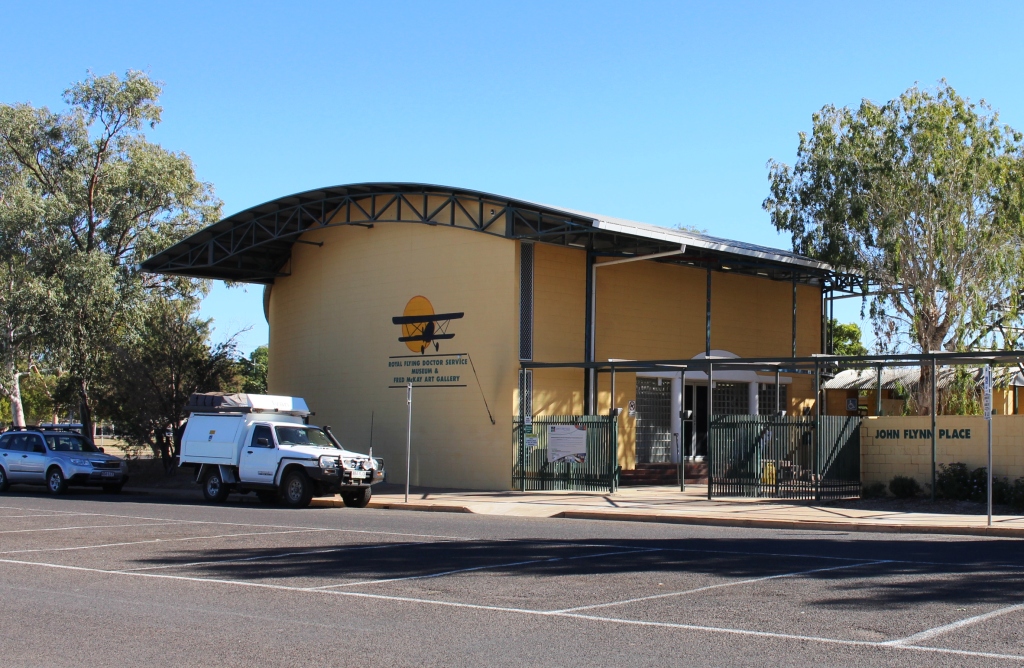
The John Flynn Memorial Museum in Cloncurry

The John Flynn Memorial Museum in Cloncurry

The overnight stop in Cloncurry provided an opportunity to visit the Dr. John Flynn Memorial Museum. The first Flying Doctor flight took place in Cloncurry. H.V. McKay of Sunshine Harvester Company fame had left 2,000 pounds to Flynn to start the service, to be available if the Presbyterian Church raised another 3,000 pounds. With fund raising complete, Hudson Fysh (later Sir Hudson) who had commenced the air service that became Qantas, made an aircraft available and what we now know as the Royal Flying Doctor Service was born. Flynn! McKay! Fysh! All towering figures in their fields! No wonder the R.F.D.S has become such a success.

If you visit Cloncurry, the museum is worth some of your time. It tells the story in detail and is supplemented by a fine art collection. We have visited Flynn’s grave near Alice Springs, the memorial to him by the Stuart Highway north of Tennant Creek and the small town of Beltana in South Australia where the R.F.D.S concept was born in Flynn’s mind. To finally visit the memorial museum was a very special experience.


The West MacDonnell Ranges

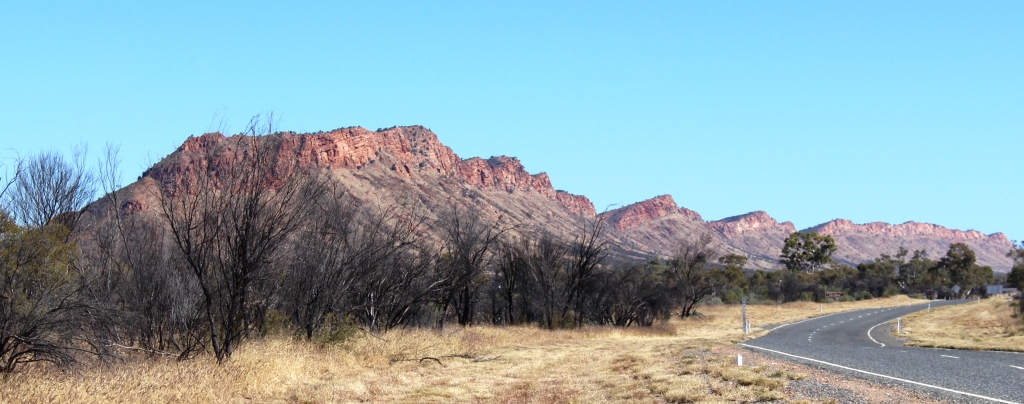
To drive from the East MacDonnell to the West MacDonnell Ranges on the same day provided an opportunity for comparison that we did not have last visit, as the visits were separated by two days of rain. Today we couldn’t miss it. The difference in the topography of the areas is striking.

The first real MacDonnell Range after leaving Alice Springs

The first real MacDonnell Range after leaving Alice Springs

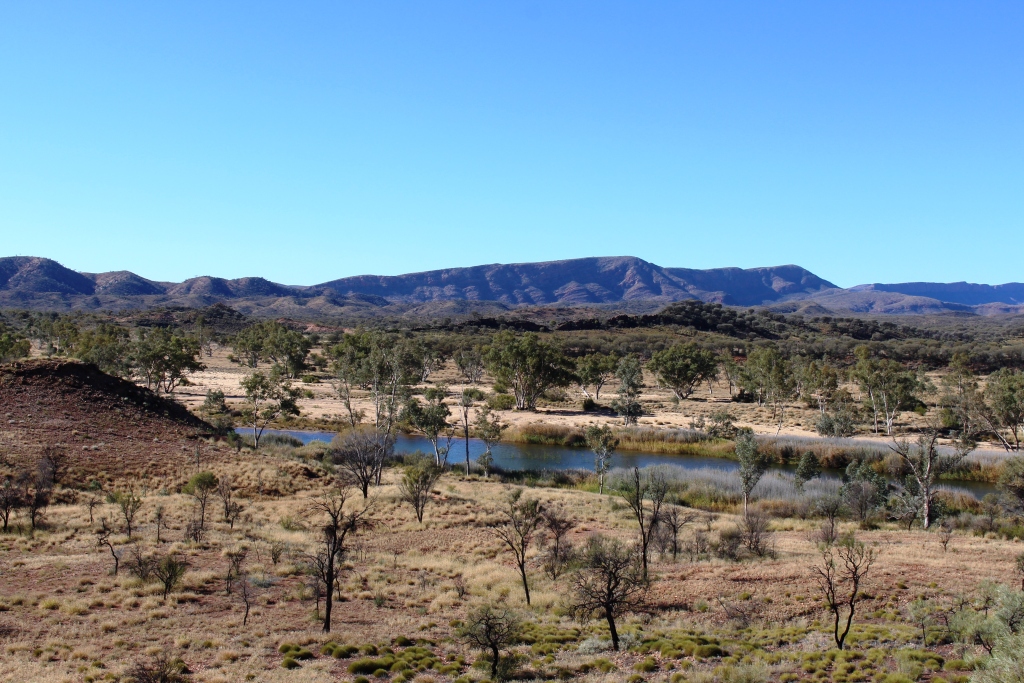
Mountains in the eastern section are predominantly bold red rock structures with massive rocky mounds descending to less prominent lower slopes. By contrast, the western ranges are mostly lightly vegetated lower slopes that comprise perhaps 85 to 90 percent of the height with the remainder a crown of reddish stone perched at the top, like a Great Wall of China. For much of the distance along Namatjira Drive, the mountains are away from the road, giving a feeling of space while for much of

The more distant ranges of the West MacDonnells

The more distant ranges of the West MacDonnells

the Ross Highway the mountains totally dominate with each break in the rocky range revealing yet another red rocky row. But that doesn’t mean that the western end of the MacDonnells is inferior. Not in the least. Just different!

But the MacDonnell Ranges are different in another way. Unlike most mountain ranges, the rivers that flow from them do not have their source in the mountains themselves but in the generally flat, but more elevated country, to the north. The passages

The Finke River enters the gorge at Glen Helen via a large waterhole

The Finke River enters the gorge at Glen Helen via a large waterhole

through which the rivers and creeks flow are called gaps if they are so short that you can see right through or gorges if you can’t. Some of the gorges are quite long and twist through the ranges.

Glen Helen Resort has been developed from an outstation of Glen Helen Station. It has operated as a resort for many years, so it is old and its camping facilities are basic, but it has power and hot showers and that is all that mattered with morning temperatures near zero.

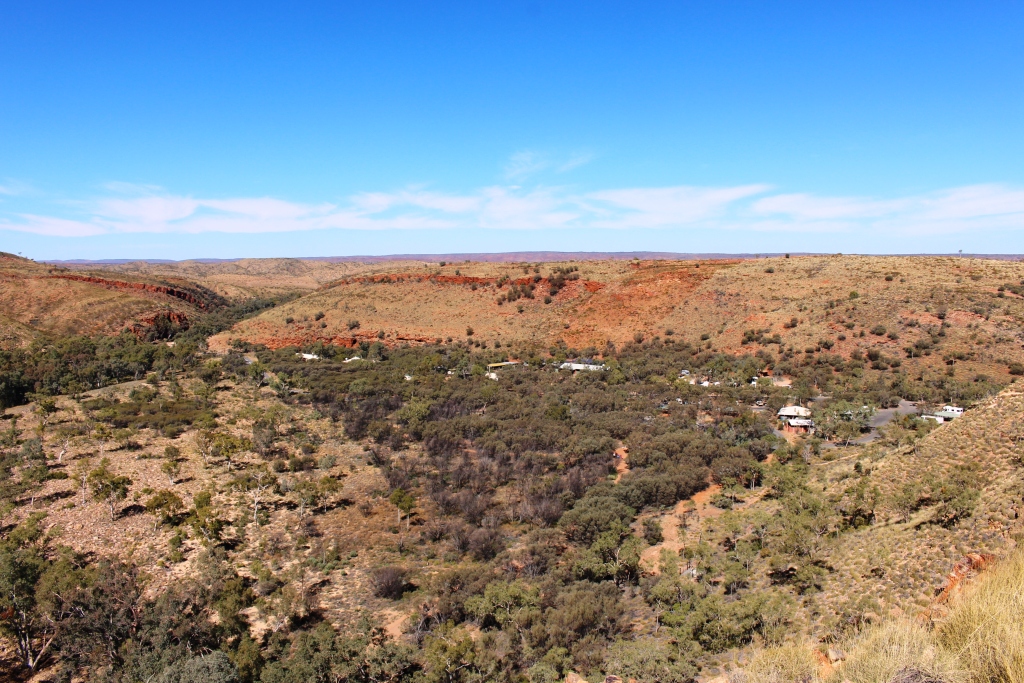
Glen Helen Resort faces the Finke River and the dominating red cliff

Glen Helen Resort faces the Finke River and the dominating red cliff

The resort buildings are located on the banks of the Finke River overlooking a permanent waterhole and facing directory into the red cliff of sandstone that is the river’s southern bank. A few hundred meters downstream the river turns right, forms a lagoon and passes through a gap in the cliff into the Glen Helen Gorge. It is a very attractive place.

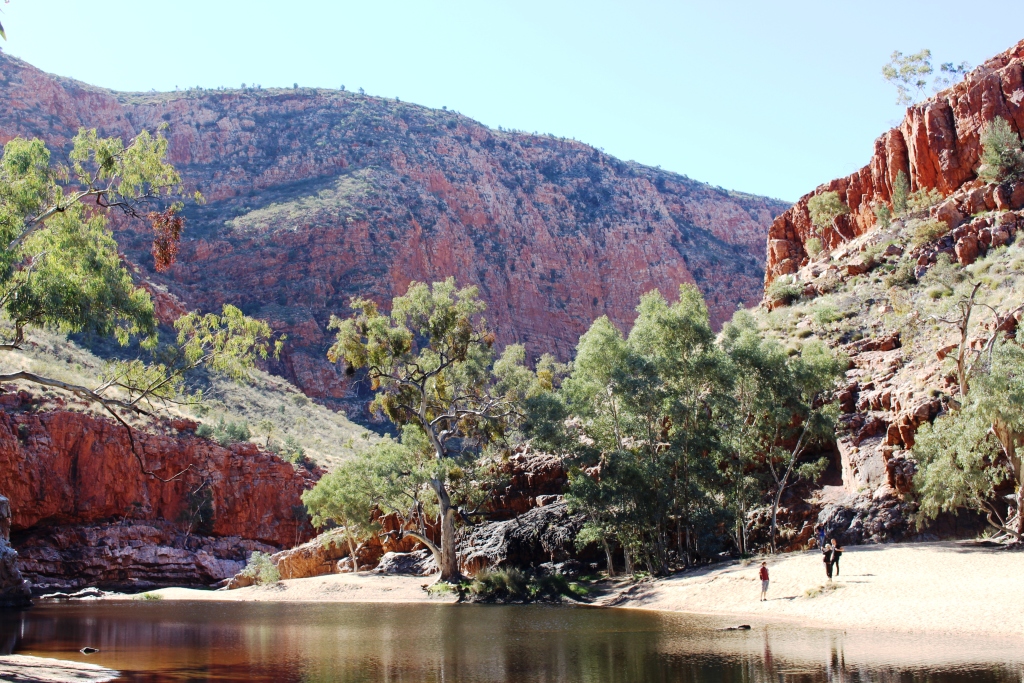
Just four kilometers back towards Alice Springs, a sealed road gives access to the most spectacular gorge and the one

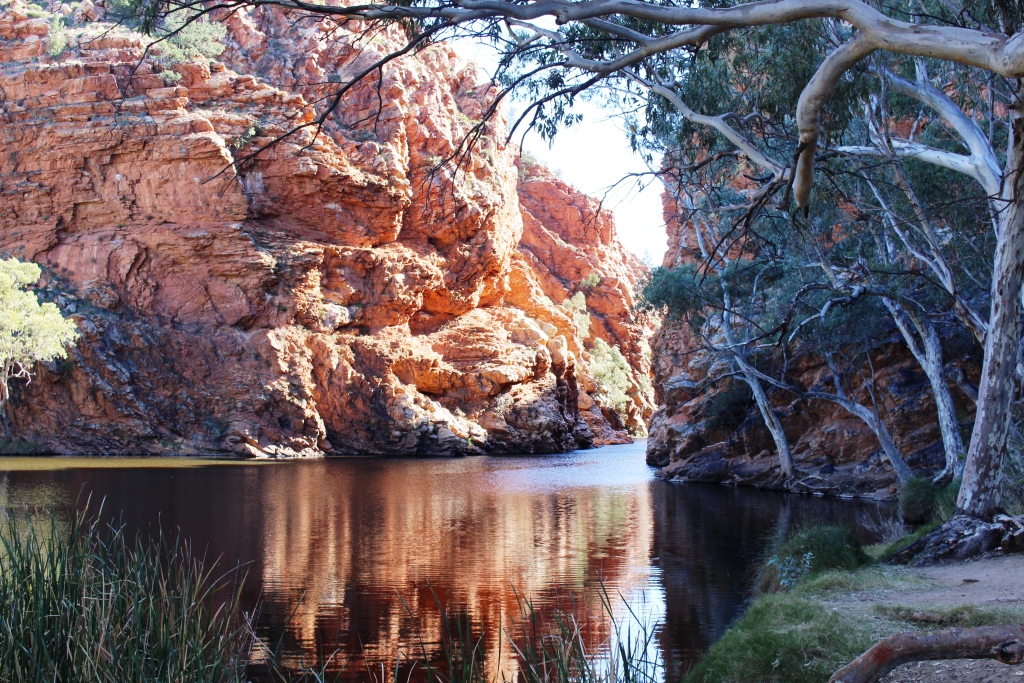
The waters of Ormiston Gorge

The waters of Ormiston Gorge

most developed for tourism, in the area. Ormiston Gorge is upstream of Glen Helen on the Finke River. The entrance to the gorge contains a large permanent waterhole which is vital for wildlife and makes it possible for a ranger station and a substantial camping area to be accommodated. There is also a commercial kiosk providing snacks and supplies.

Ormiston Pound from the Ghost Gum Lookout

Ormiston Pound from the Ghost Gum Lookout

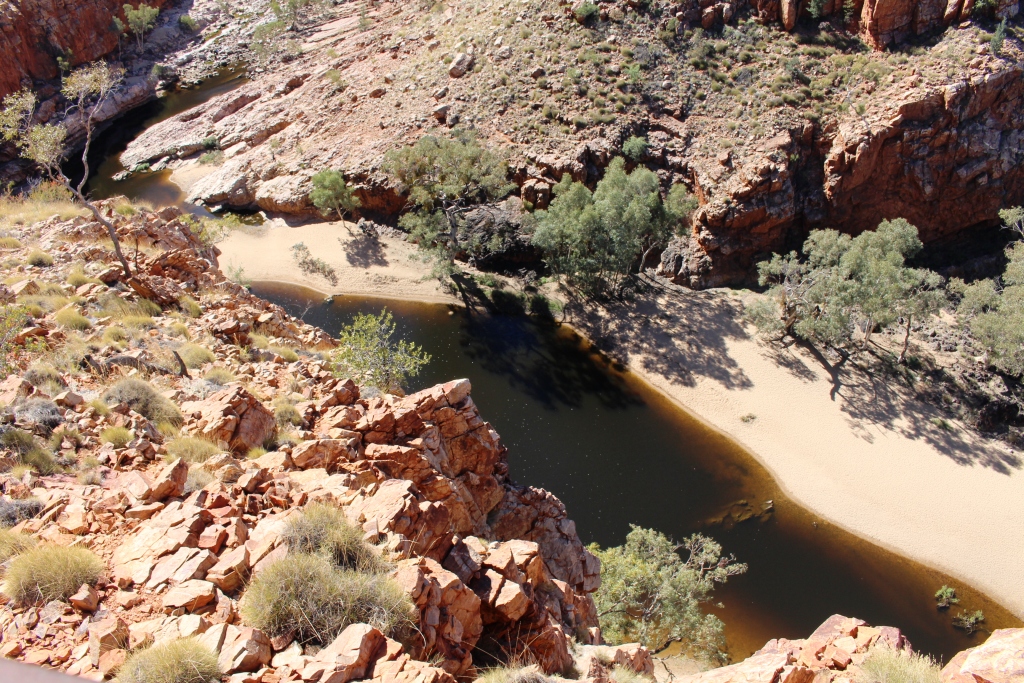
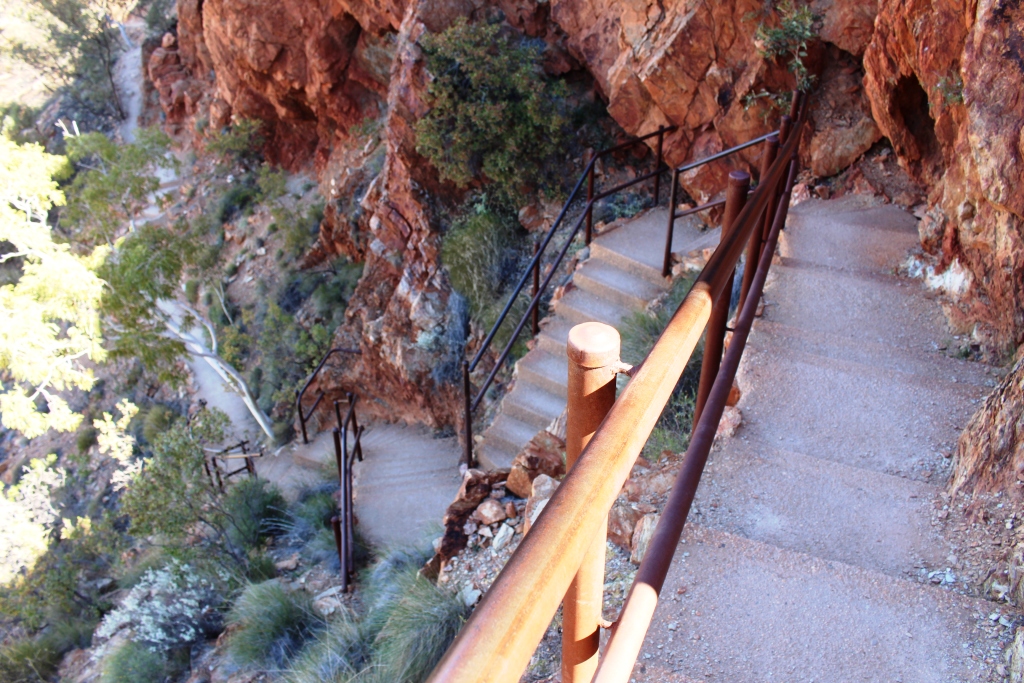
Walking tracks of varying levels of difficulty are provided. The walk to Ghost Gum Lookout involves a bit of a climb, including several flights of stairs but the view from the top makes it all worthwhile. The well defined path can be followed further into the gorge, finally reaching the bed of the river for the return journey. A longer walk traverses the Ormiston Pound, a natural feature near the main gorge..


The Finke River, as viewed from the lookout, is the heart of the gorge

The Finke River, as viewed from the lookout, is the heart of the gorge

The staircase to Ghost Gum Lookout

The staircase to Ghost Gum Lookout

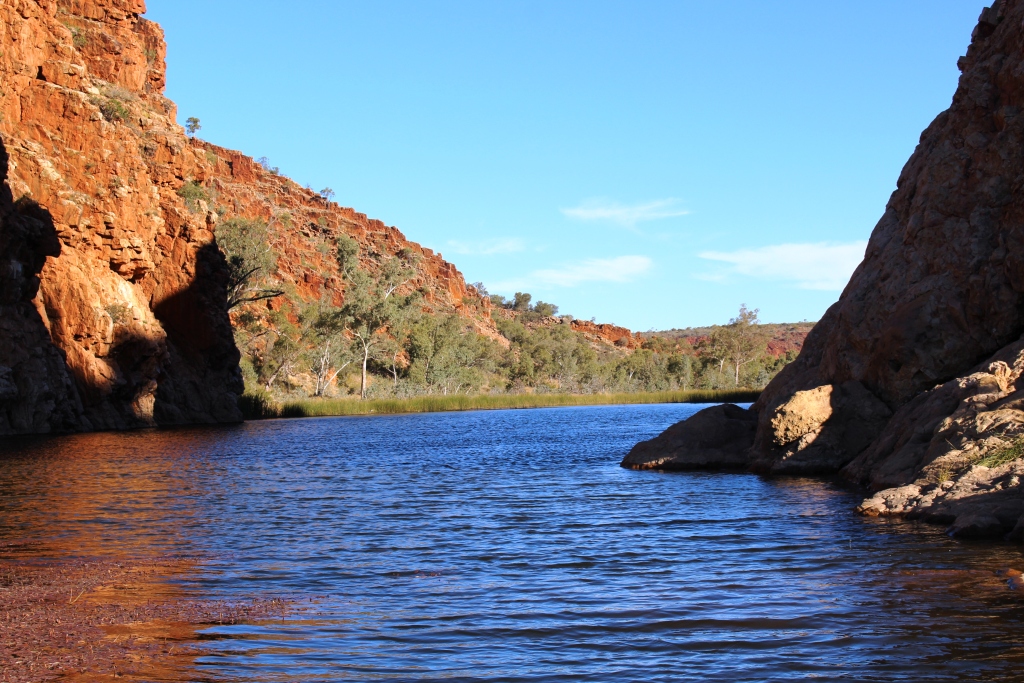
Ellery Creek Big Hole

Ellery Creek Big Hole

There are many other attractions in the area. Most involve gorges, gaps and streams. Located nearer to Alice Springs Simpson’s Gap and Standley Chasm are popular with tourists, the latter particularly at midday when the sun is directly overhead. Tourists wait and watch while the west wall moves into shadow and the right wall is slowly illuminated.

Billabongs in the Finke River between Glen Helen and Ormiston Gorge

Billabongs in the Finke River between Glen Helen and Ormiston Gorge

Further out Ellery Creek Big Hole, Serpentine Gorge and Red Bank Gorge continue the gorge theme while the Ochre Pits are neither gap nor gorge but the banks of a stream rich in the pigmented material. It is a tangible link to Indigenous history. Further west still Tyler Pass provides excellent views and Goose Bluff shows what happens when an asteroid collides with the Earth. We didn’t venture that far west.

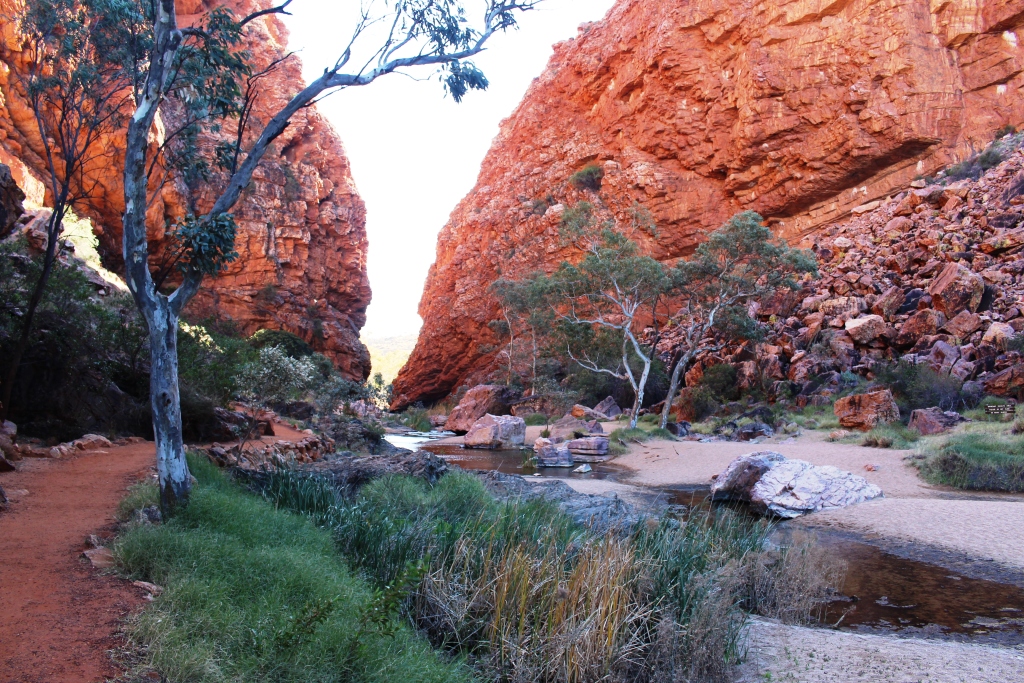
We called in at Simpsons Gap on our way to Palm Valley

We called in at Simpsons Gap on our way to Palm Valley

With the exception of Simpson’s Gap and Standley Chasm, which are accessed from Larapinta Drive, most features are located along Namatjira Drive, which diverges from Larapinta Drive about 50 km from Alice Springs and runs generally west. If you follow Larapinta Drive you will pass the turns to the 4WD only areas of Wallace Rock Hole and Boggy Hole and ultimately, about 80 km further on, reach Hermannsberg, best

The area that inspired painter Albert Nanatjira

The area that inspired painter Albert Namatjira

known as the home of Aboriginal artist Albert Namatjira and the location of the pioneering Hermannsberg Lutheran Mission. A memorial to Namatjira stands beside the road just east of the town and the historic mission buildings are open for inspection for a modest fee.


The road runs through the bed of the river

The road runs through the bed of the river

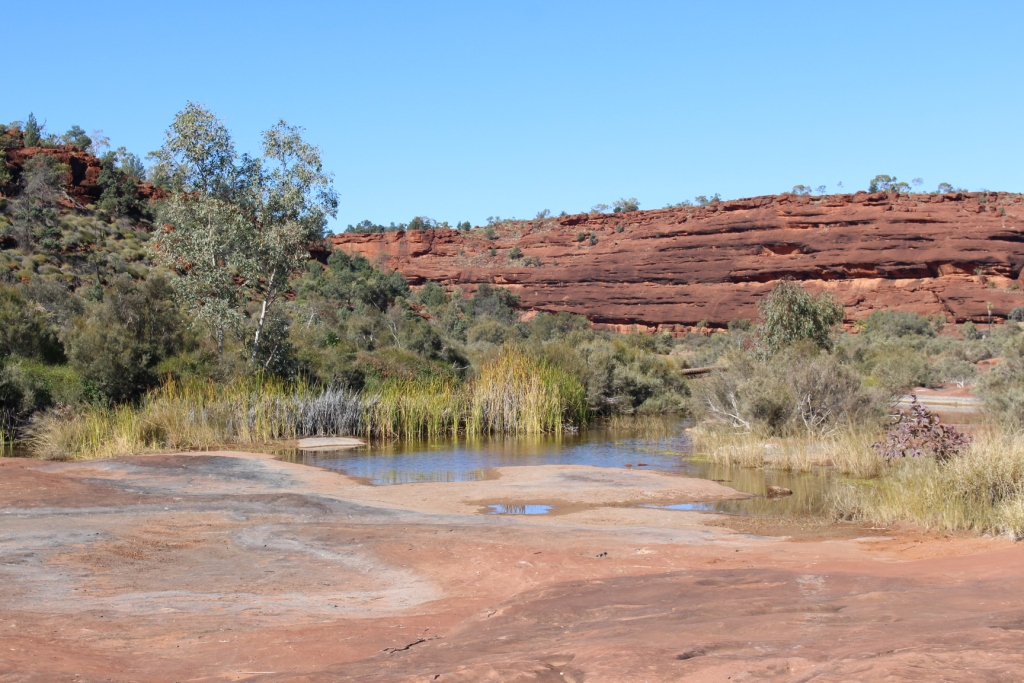
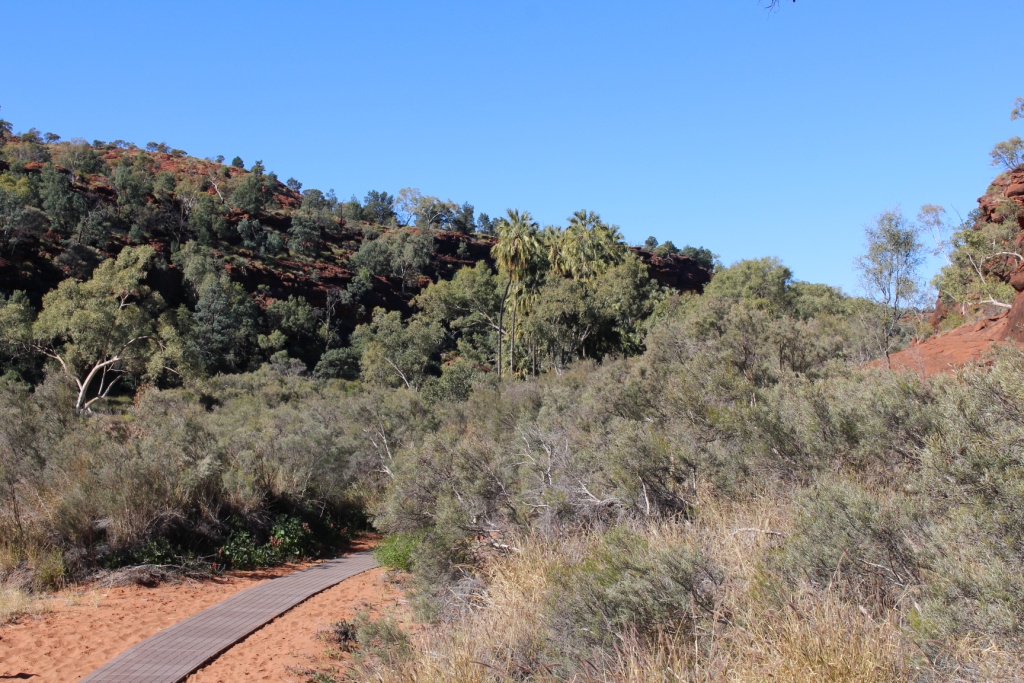
But south of Hermannsberg, and also on the Finke River, lie the wonders of Palm Valley. This visually stunning place is, because of the roads, is restricted to 4 wheel drive access, so tourists who lack such a vehicle need to hire one or take a tour. The part of the valley where the palms are found is only 20 km from Hermannsberg but the drive took about an hour each way. The road mostly follows the Finke

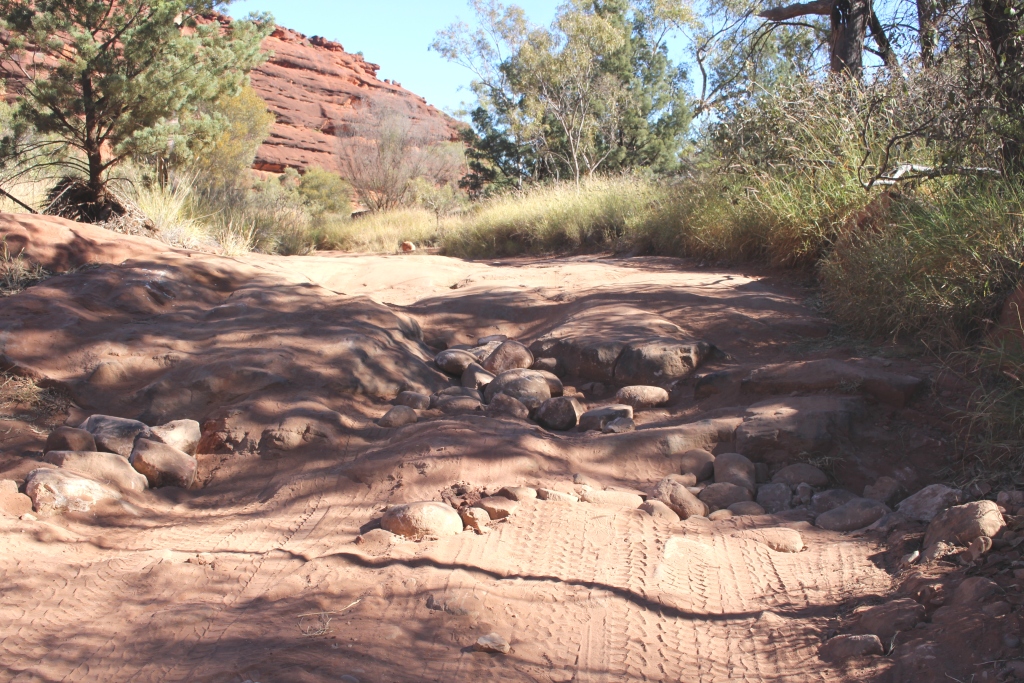
A challenging part of the drive

A challenging part of the drive

River and then Palm Creek. It is often in the bed of the stream, alternates between upgraded gravel and sand and towards the final destination negotiates huge rocks that are neither gradable nor movable.

The Finke River Gorge is the longest such geographical feature that I have ever seen that gives so many wow experiences for its length. The river bed takes most of the width of a wide river valley. It is confined by two facing almost continuous lines of rocky cliffs, deep red in colour and of infinitely different and changing shape. The driver is continually conflicted between the imperative of the road and the demands of the views.

A stand of the rare Red Cabbage Palm that are unique to the area

A stand of the rare Red Cabbage Palm that are unique to the area

After 12 km the road leaves the Finke Gorge and follows the smaller Palm Creek. Two km further and you reach the day use and camping areas. The final information shelter is a further 4 km. The challenge to the driver increases as the journey progresses. We drove through Cycad Gorge, most appropriately named, to within a kilometer of the objective and I walked the last kilometer and walked a further 500 meters or so along the combined route of two of the walks.

The start of the walking track that leads to the palm trees

The start of the walking track that leads to the palm trees

If I knew than what I know now we would have started earlier and not looked at other things on the way. From the lush green of the Australian Red Cabbage Palm to the array of reds that emphasise the walls of the gorge, there is so much to see that it is hard to know what to look at first. Our original plan was to take the van in to the National Park camping area, but we could not get satisfactory information on the road. Having now driven the

The church building at the Hermannsberg Mission

The church building at the Hermannsberg Mission

road I am still a bit undecided but on balance I think we would have got in and back out without problem.


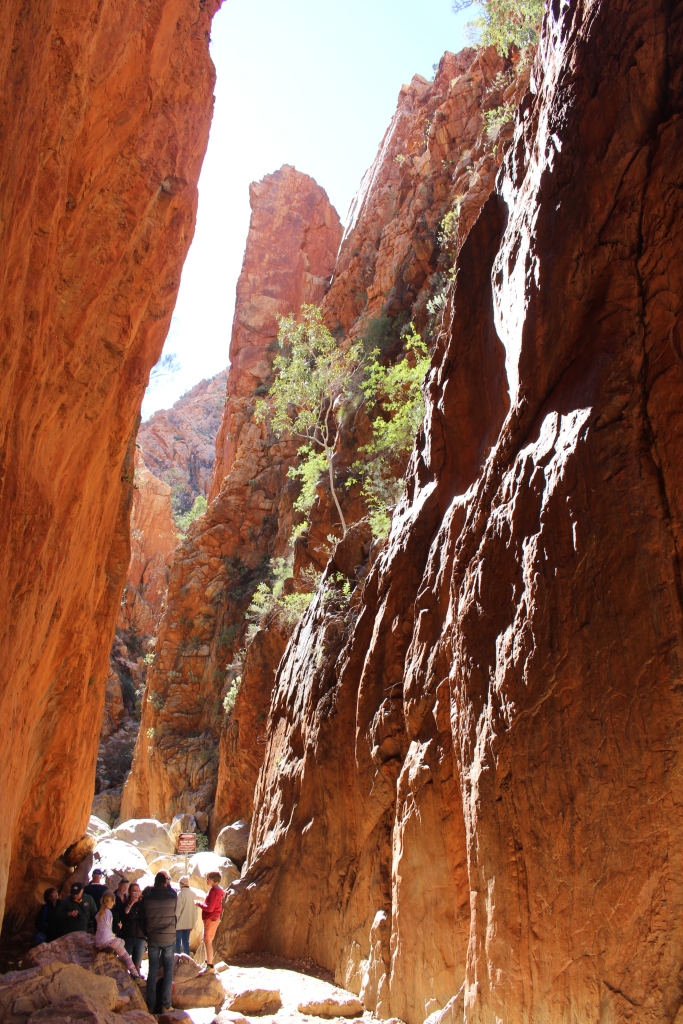
The first view of the sun illuminating the Chasm

The first view of the sun illuminating the Chasm

As a final tourist participation in the Red Center, we visited Standley Chasm, timing our visit to coincide with the sun reaching its zenith. I took the walk on my own, as it was a bit rough for Ruth’s knee. It was school holidays, of course, and children were everywhere, one large school group and numerous family groups as well as other oldies on their own. Like all days lately the sky was cloudless blue but the chill wind blowing through the chasm had most seeking the sunny side of the narrow floor area. Wind resistant clothing was the norm.

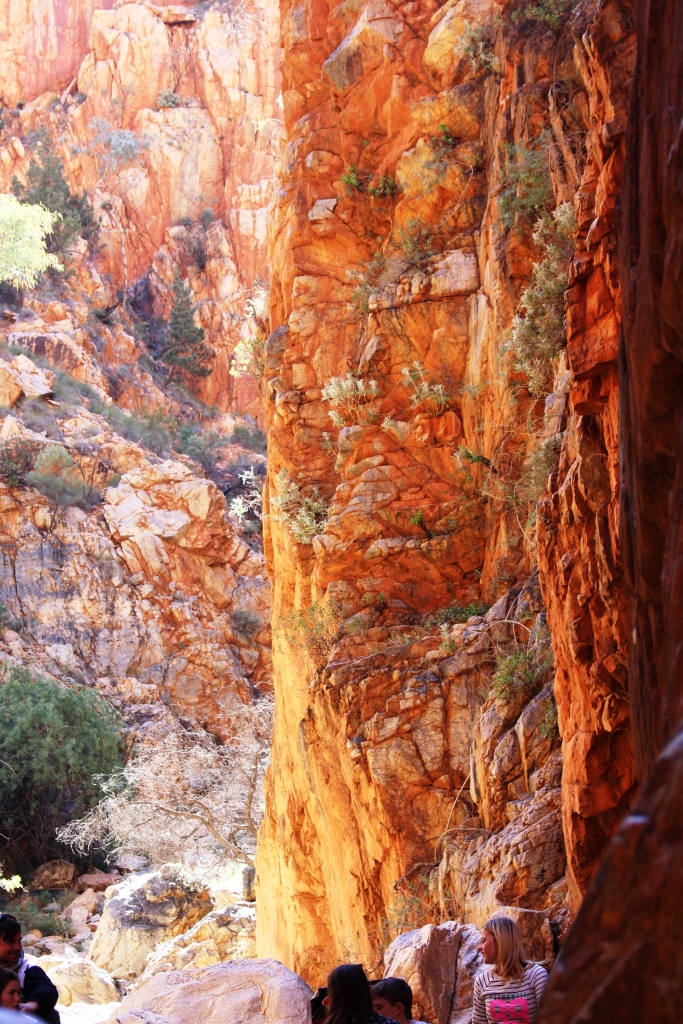
Colours in the rocks behind Standly Chasm

Colours in the rocks behind Standly Chasm

The chasm is a wonder of nature. It becomes a water course when it rains. You follow a stream to reach it. From that point of view it is just another gap in the range but certainly one that has caught the attention of the public over a long period of time. It is interesting to watch the west wall move into shade and the sun slowly bathe its eastern counterpart in light, and the claimed fantastic colours were worth waiting for. Interestingly it is the rock face immediately behind the chasm itself that produces the most striking colours. Perhaps the narrow chasm has the effect  of concentrating light on the south facing rock face beyond its limits, but one thing is clear. It is a photographers paradise.


The sun starts to illuminate the eastern face of the chasm

The sun starts to illuminate the eastern face of the chasm

More of the rocks behind the main chasm

More of the rocks behind the main chasm

The East MacDonnell Ranges

Our plan had been to take the van into the East and West MacDonnell Ranges and spend nights in various National Park camping facilities. But on our first morning in Alice Springs I woke with cold feet, so checked the Weather Channel’s app to find that the temperature was zero, but felt like – 3. The forecast made it clear that there would be no improvement over the next week or so. So the imperative become to find somewhere with electricity.

Fortunately, both areas have bush resorts with caravan parks attached that have powered sites available. So the new plan is fixed. The Ross River Resort for two nights, then Glen Helen Gorge Resort for two more and then back into Alice Springs for a final two nights.

Emily Gap from the north or "other side" of the mountain

Emily Gap from the north or “other side” of the mountain

We have covered this area before, but had missed some attractions through rain that had derailed our plans. There is, however, nothing wrong with a revisit or two. So for a start we revised Emily and Jessie Gaps. One of the unique features of the MacDonnell Ranges are the gaps that cut through them. These gaps take the form of creeks that carry water from the higher ground on the north side of the range to the lower south side and ultimately to the desert. Both flow into the better known Todd River.

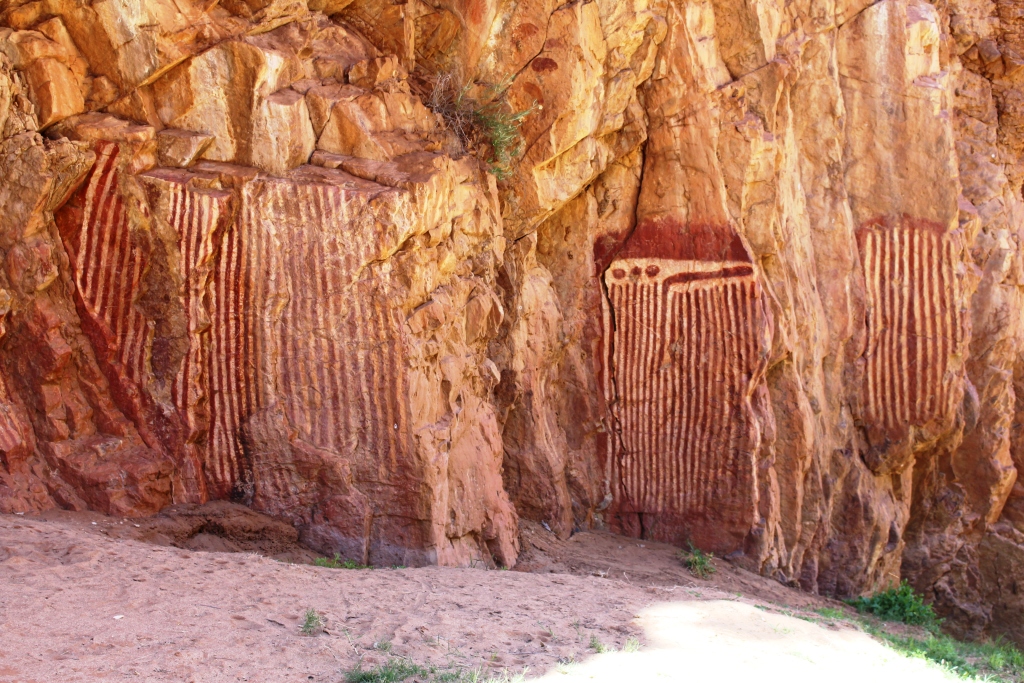
Aboriginal carvings of  sacred catapillars

Aboriginal carvings of sacred catapillars

When we were here four years ago Jessie Gap was full of water but this year both are dry, as is Trephina Gorge, which was to have been our base in the area, until the cold weather sent us looking for electricity. As an alternative, we had planned to have lunch there, but the road in was quite rough so we decided to put the van on site at Ross River and return later in the day.

Trephina Bluff overlooks the gorge

Trephina Bluff overlooks the gorge

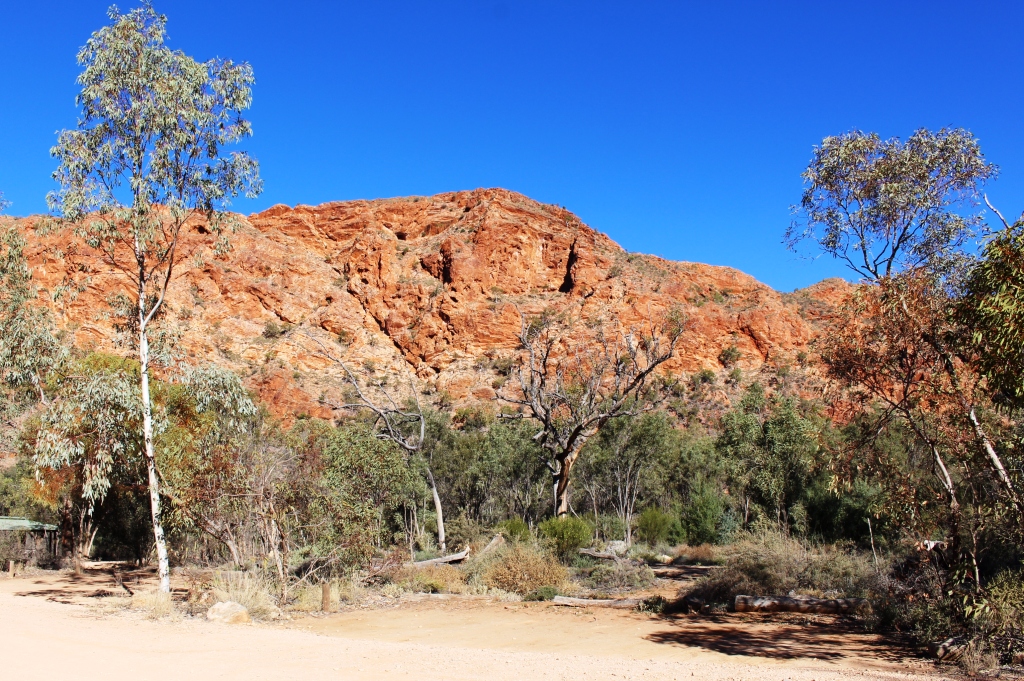
Trephina Gorge is worth a visit at any time. Trephina Creek runs a twisted course between rust red rock cliffs under the watchful eye of precipitous rust red mountains, including Trephina Bluff that provides a backdrop for campers. The mountains are decorated with green vegetation which includes white boughed ghost gums that really stand out against the vivid red of the rocks.

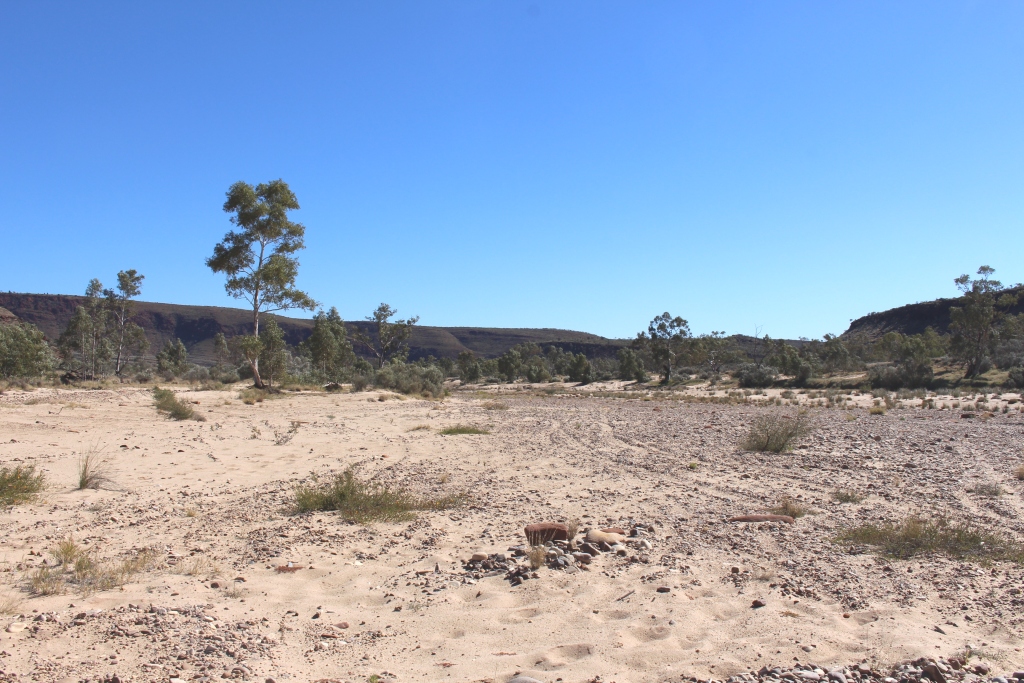
A very dry Trephina Gorge.

A very dry Trephina Gorge.

Four years ago Trephina Creek was flowing, but this time it is completely dry. But the lack of water allowed us to walk further along the creek bed and gain a much better understanding of the area above the gorge.

Ross River Resort is like Gemtree Caravan Park, in that it is situated on a sealed highway part of which becomes a link between two parts of the very unsealed Binns Track. In both cases a section of the Binns Track ends at the highway and it is necessary to travel a short distance on the highway to reach the next part of the Track.

A rutted start to this section of the Binns Track

A rutted start to this section of the Binns Track

Ross River Resort is an older bush establishment sighted around the original station homestead with basic accommodation in older style cabins. About one kilometer away, on the opposite side of the Binns Track the very spacious camp ground is almost tucked in between two mountain ranges. Facilities are basic but clean and everyone is friendly.

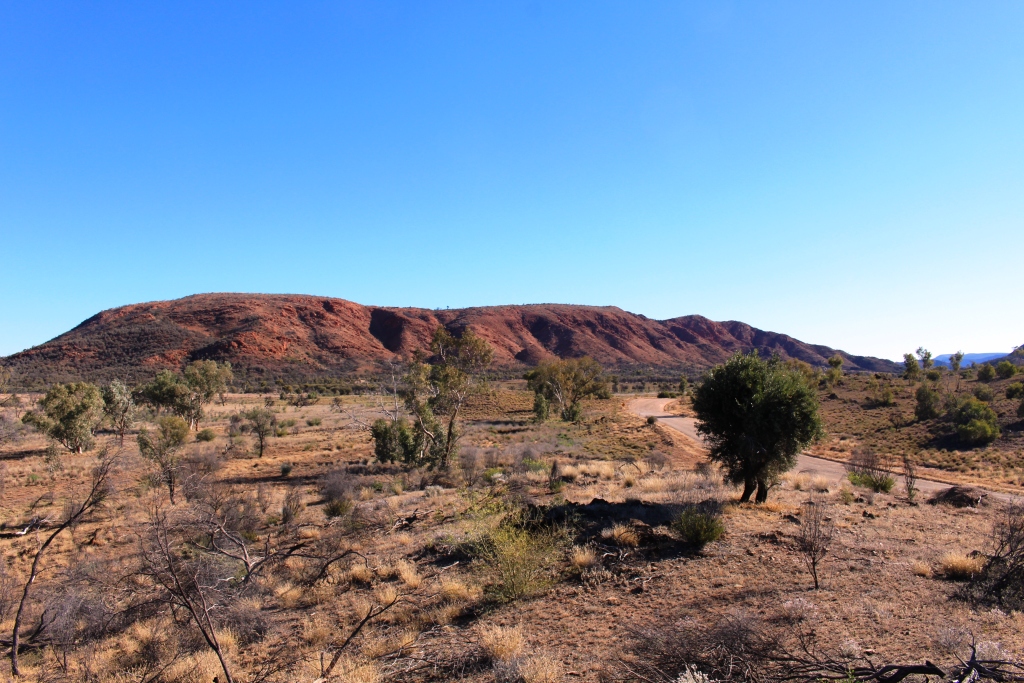
Mountains on the drive to Arltunga

Mountains on the drive to Arltunga

In addition to places already mentioned we had on our list the N’Dhalia Gorge which is only a few km down the Binns Track from Ross River and the Arltunga Historical Reserve, about 40 km to the north. N’Dhalia Gorge was scratched when I baulked at a water crossing where the track crosses the Ross River just near the camp ground. I am not confident with water crossings and found later that this one was OK, but by that time it was too late in the day. Arltunga was a different matter.

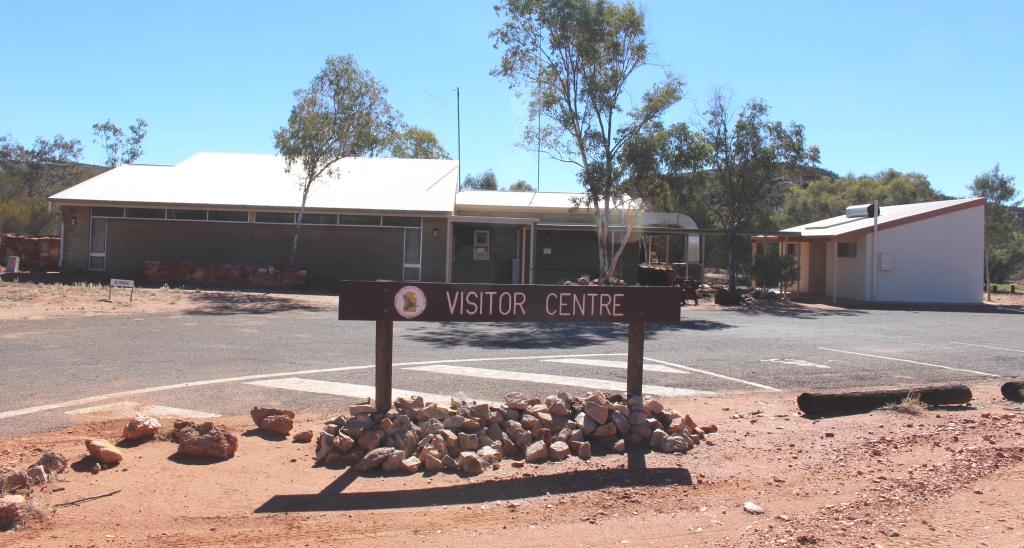
Arltunga Visitor Information Centre

Arltunga Visitor Information Center

The old gold town of Arltunga was the first European settlement in Central Australia. Explorers found what they thought were rubies so a ruby rush started. But the gems were almost worthless garnets. Two of the disappointed miners decided to look for other minerals and found gold. South Australia now had its very own gold rush. South Australia had responsibility

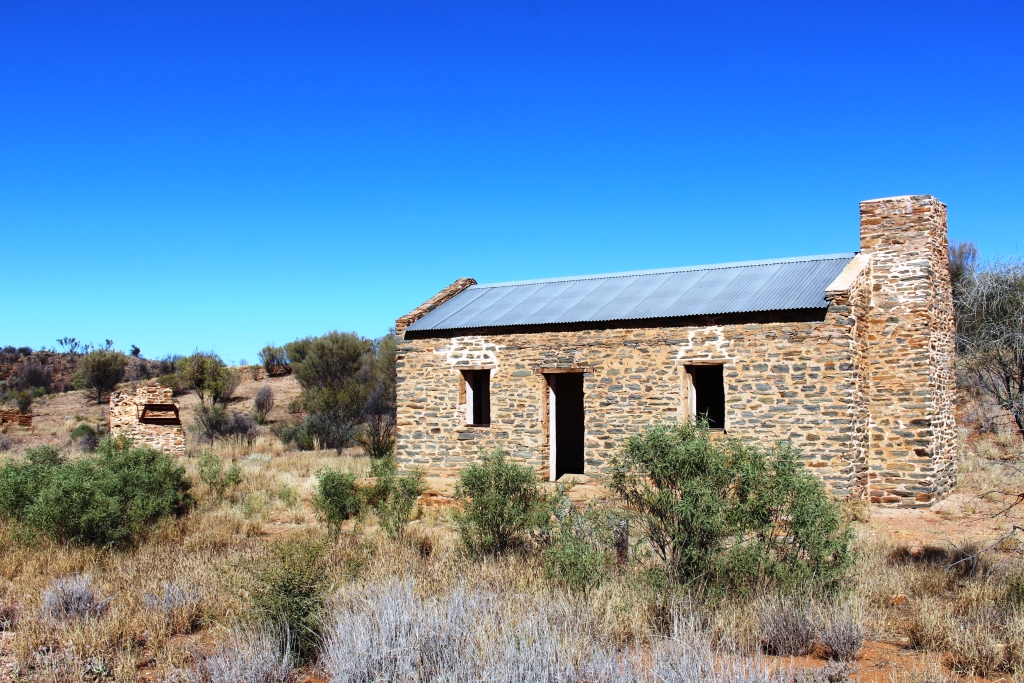
Restored managers residence at Government gold processing facility

Restored managers residence at Government gold processing facility

for Northern Territory at that time. The gold find and subsequent development of the town of Arltunga lead to the SA government deciding to commit to Central Australia. They established the town of Stuart the name of which was later changed to Alice Springs.

Arltunga was 800 km from the rail head at Oodnadatta. Miners had to find their own way along the route of the overland telegraph line to

Restored police station and lockup

Restored police station and lockup

Alice Springs and then travel through the East MacDonnell Ranges to Arltunga, a further 100 km or so, often pushing their meager belongings in a wheelbarrow.

Because the area is so isolated, when the gold ran out the residents simply left and the process of deterioration commenced. Nothing was built in its place. Buildings were constructed from the stone of the surrounding countryside so have been easy to rebuild. There is an information center that does an excellent job of telling the story and also supplies excellent maps and other material.

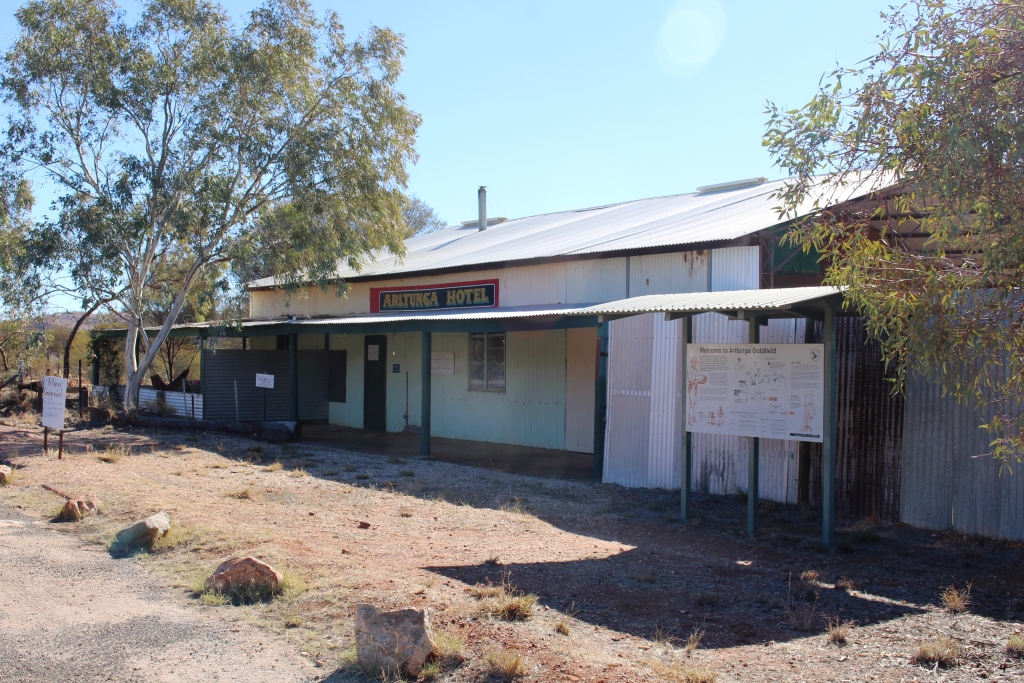
The now closed Arltunga pub

The now closed Arltunga pub

Buildings have been restored at the site of the government ore processing battery while the police station and lockup look ready for the return of officers and miscreants. Gold mining was both alluvial and underground. Two underground mines are available for inspection by those who remember to bring a torch.

Another roadside mountain range

Another roadside mountain range

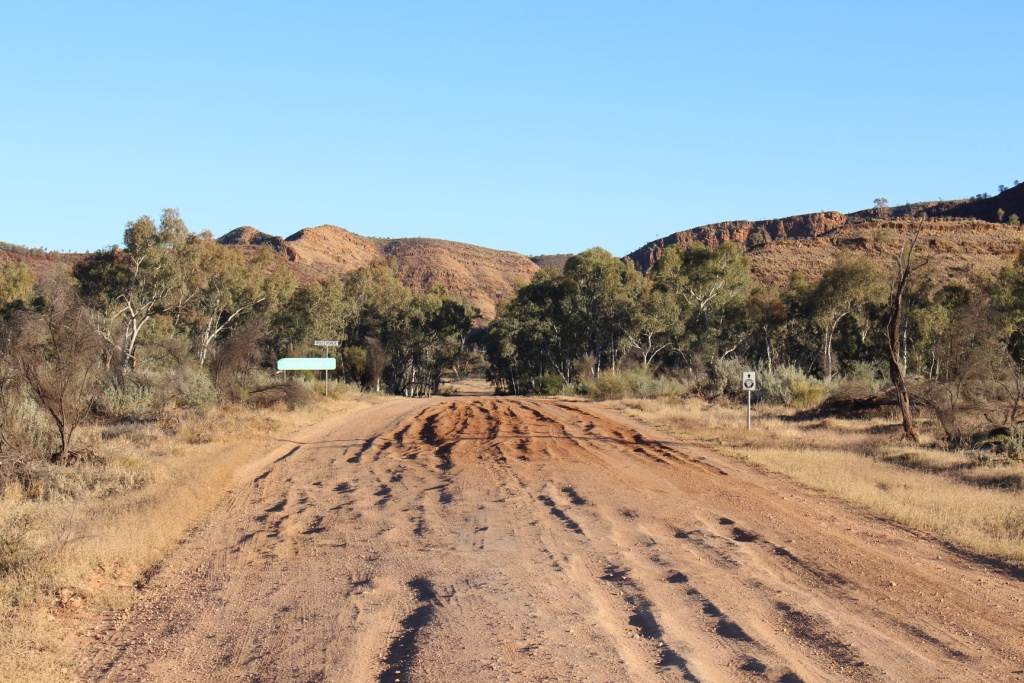
The drive from Ross River to Arltunga is superb. The road goes through a pass that follows the course of the dry Bitter Springs Creek and then runs along adjacent to the northern face of a most picturesque red mountain range. Turning northeast it parallels another range of a different hue, crosses a plain and reaches Arltunga at the foot of the next range of hills. The gravel road varies from a few areas of vehicle destroying corrugations to smooth surfaces, but most of the way it was like most gravel roads – light corrugations that can comfortably be taken at 60 mph.

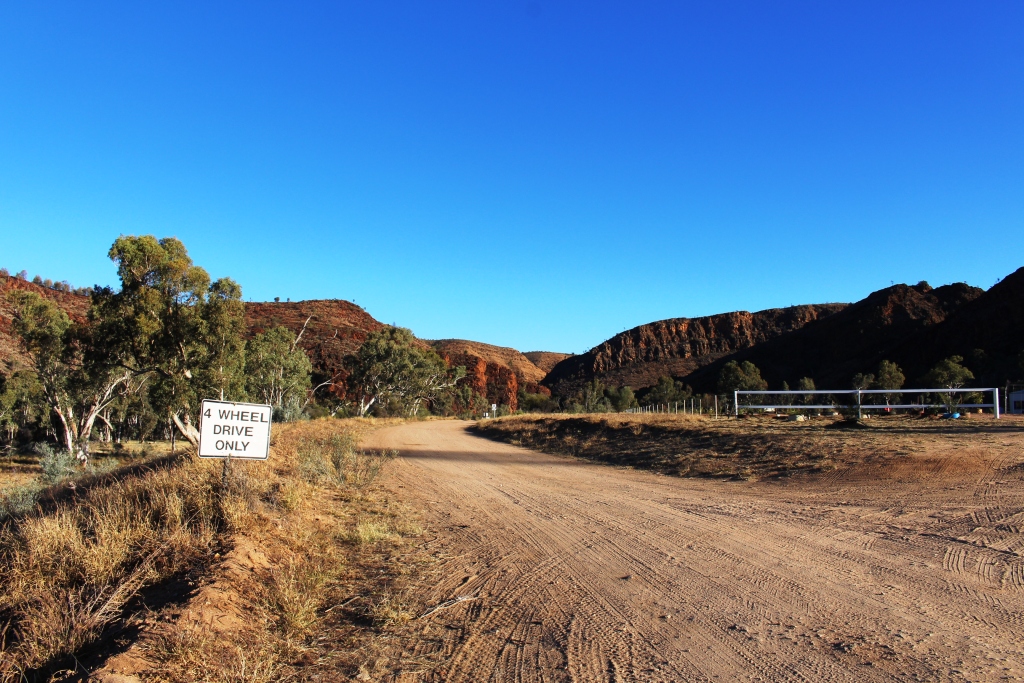
The Binns Track south towards D'Halia Gorge.

The Binns Track south towards N’Dhalia Gorge.

The East MacDonnell Ranges tend to be overshadowed by their Western counterparts, probably because the latter have more marketable features that attract the “been there done that” and the “bucket list” people. But I am more an ambiance person. I like just being in the East MacDonnell Ranges, because of the atmosphere that results from the colour, form and variety of scenery that makes the place so unique.